
Waterfront pool safety in Coral Springs starts with two questions: can someone reach the swimming pool from the house, and can they reach the lake or canal beyond the yard? A fence around one body of water does not automatically answer the other question.
That distinction matters when you are planning a removable fence on the pool deck. You might want to keep the patio usable, preserve the water view and leave room for maintenance. Those are reasonable goals. The route still needs to make sense when a sliding door opens, a visitor arrives through the side yard or a service worker needs access.
This waterfront pool safety guide addresses that specific layout problem. For product options and an estimate, see our Coral Springs pool safety fence service page. Here, we will work through the questions that help you arrive at a better plan before anyone starts drilling.
The practical answer: map the pool and the waterway separately, identify every route from the home to each, and ask the appropriate city and drainage-district offices about any proposed waterside fence. A pool-deck barrier and a property-line fence can have different jobs and different review requirements.
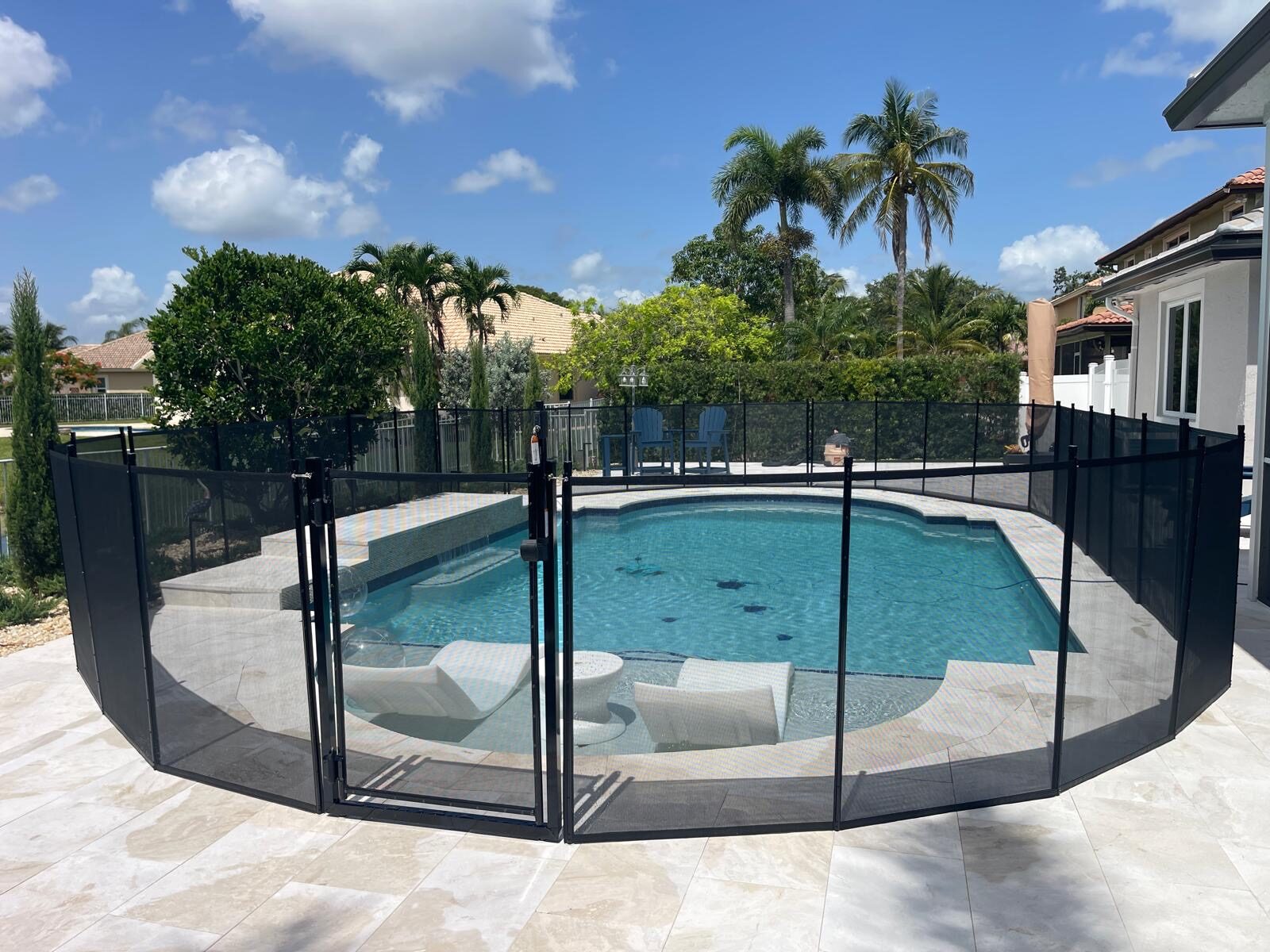
1. Map both water hazards before choosing a fence line
Start with a simple sketch rather than a product brochure. Draw the house, pool, deck, side yards and rear waterway. Add the doors that people actually use, including a cabana bathroom door or a garage-to-yard door if your home has one. Then draw the paths people take to the outdoor table, grill, pool equipment and rear lawn.
Use one color for access to the pool and another for access to the lake or canal. This makes it easier to see the problem that a single fence line may hide. A person can be outside the pool enclosure yet still have an unobstructed route to natural water.
Coral Springs’ Fire Department water-safety guidance specifically discusses backyard pools, canals and ponds. Its prevention advice includes separating water hazards from home access and keeping barriers in place when the pool is not in use. Treat that as safety guidance; the approved design and applicable codes determine the requirements for a particular project.
Walk the sketch in person. Stand at each door and ask where a child could go without encountering a closed barrier. Do not test this with a child. Adults can inspect the routes without creating a dangerous experiment.
Your waterfront pool safety sketch should answer these questions:
- Which parts of the patio can be reached without entering the pool area?
- Does the route to the rear lawn pass through a pool gate?
- Is there a side path around the end of a proposed fence?
- What separates the rear lawn from the waterway?
- Which doors, gates or openings are being relied upon as part of the safety plan?
Write down anything you cannot answer. An unanswered question is a reason to review the layout, not a reason to assume the missing protection exists.
2. Separate the two waterfront pool safety jobs
A removable mesh fence can define a pool zone inside a larger backyard. A property-line fence may define the outer edge of the property. They are not interchangeable simply because both are called fences.
Consider an illustrative layout: a home opens onto a covered patio, the pool sits to the right, and a lawn extends behind the deck toward a canal. A fence separating the patio from the pool may reduce direct pool access while leaving the route from the patio to the canal unchanged. The pool portion of the plan could look finished even though the overall waterfront pool safety problem remains.
Now consider a different example: a perimeter fence surrounds the backyard, but the home’s sliding door opens inside that perimeter. That outer fence may address access from outside the property without separating the house from the pool. The question is not whether there is a fence somewhere. It is which route the fence interrupts.
CDC drowning-prevention guidance recommends four-sided fencing that separates the pool from the house and yard, together with close supervision and other protective measures. A fence does not replace an attentive adult.
Florida law also makes distinctions between a pool barrier and a yard enclosure. Section 515.29 allows a qualifying portion of a yard enclosure to serve as part of the pool barrier under specified conditions; it does not make every backyard fence a qualifying pool barrier. Ask the building department to review the actual arrangement rather than applying a general statement to a photograph.
Our removable pool fence overview explains the product side of the decision. The site-specific waterfront pool safety decision is where that product belongs and what other water access still needs attention.
3. Check drainage and easement questions before moving toward the water
Waterfront fence planning in Coral Springs has a local administrative detail that is easy to miss. The city’s Drainage Districts page says fences bordering a waterway need approval or a letter of no objection. It also identifies the districts and provides a map and contact information.
This does not mean every removable fence positioned on a pool deck follows the same process as a fence bordering a canal. It means that the location and scope of the proposed work need to be clear. Tell the office whether you are discussing a pool-deck barrier, a rear property-line fence or both.
The city’s general fence guidelines address waterside setbacks, materials, landscaping and easements. Those general property-fence rules should not be copied onto a removable mesh layout without checking applicability. An easement on a survey is a reason to ask questions before placing a fence, not a line to ignore because a neighbor has one.
Prepare a waterfront pool safety review packet:
- Your current survey, with the proposed routes marked separately.
- Photos showing the deck, rear yard and waterway, without people in them.
- A description of the fence type and its intended purpose.
- The location of gates and any access needed for maintenance.
- Existing association or drainage correspondence relevant to that location.
Keep the responses with your project records. If an office approves one route and the plan later changes, ask whether the change needs another review. A letter about a waterside property fence should not be treated as approval of every feature of the pool barrier.
This is one place where a little preparation can save rework. It is much easier to clarify a line on a survey than to discover a restriction after holes have been drilled or materials ordered.
4. Plan daily access without making a gate a permanent shortcut
A waterfront pool safety route that looks neat on a plan can become awkward in daily use. If every trip to the outdoor table requires opening a pool gate, people may be tempted to leave the gate open. If the only equipment-access route crosses a narrow furniture arrangement, a service visit can become an obstacle course.
Before agreeing to the fence line, walk through ordinary tasks: carrying dinner outside, moving a trash container, bringing pool equipment through the yard and reaching the area that a landscaper maintains. These are planning exercises for adults, with children kept safely away from water.
Ask the installer to identify which space will be outside the pool enclosure and which space will be inside. Do not rely on phrases such as “halfway around” without a drawing that shows how the rest of the barrier is formed. A partial photograph cannot establish a complete enclosure.
For a pool-access gate, Florida’s barrier statute addresses outward opening away from the pool, self-closing and self-latching features. Have the professional explain how the proposed gate fits the applicable requirements. A property-boundary gate may also have separate zoning considerations, which is another reason not to treat every gate on the property as the same item.
Our pool fence installation information is a starting point for the installation conversation. Bring your waterfront pool safety sketch to the estimate so the discussion covers how you will use the yard, not just how many feet of fence appear on a drawing.
Be particularly careful with a gate that leads toward the waterway. Calling it a maintenance gate does not remove the access issue. Decide who uses it, how it is secured and who checks it after work is complete. If a proposed arrangement depends on everyone remembering to close an opening, ask whether the layout can be improved.
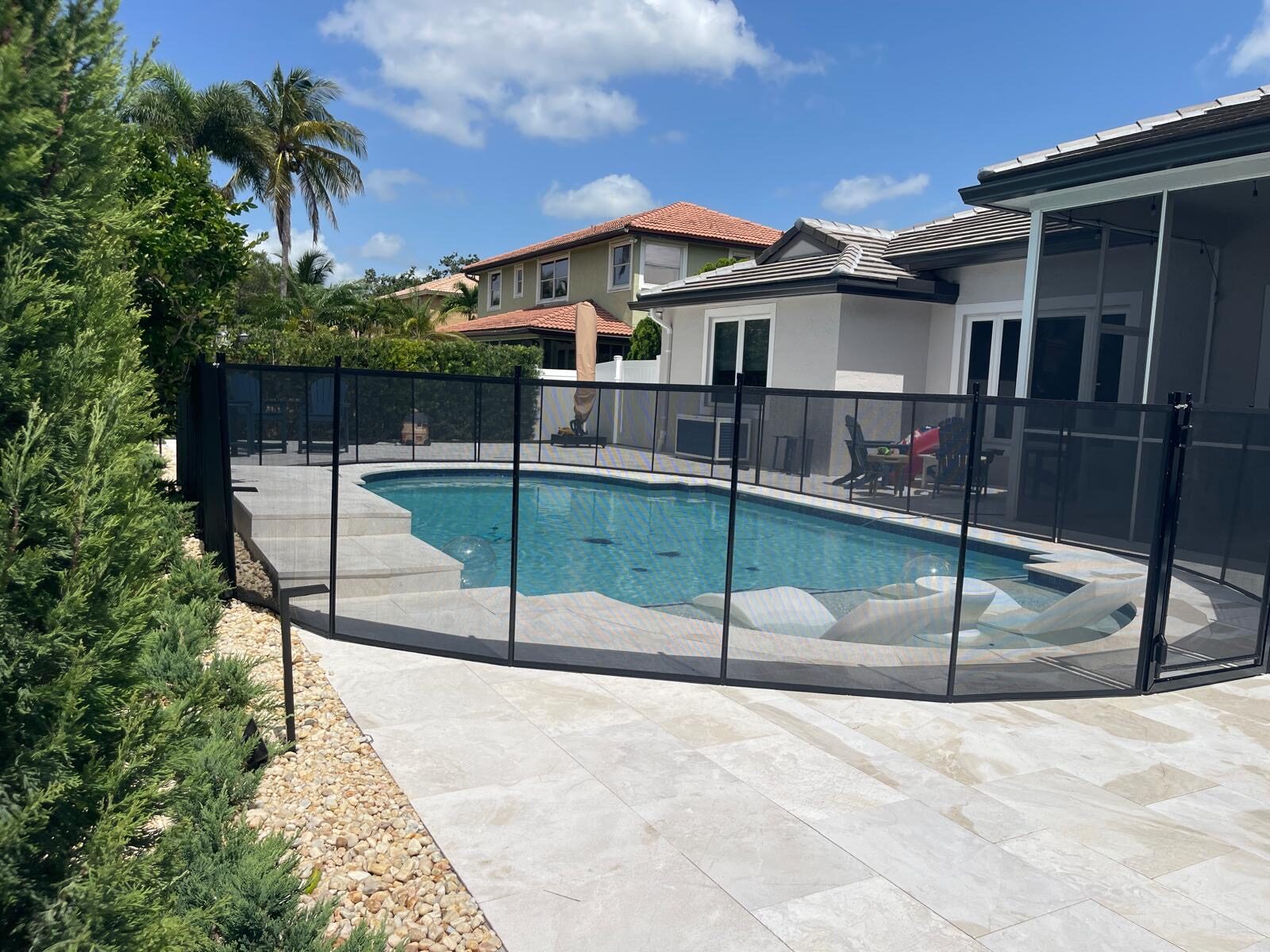
5. Look at furniture and landscaping as part of the layout
Waterfront pool safety planning continues after the poles are marked. Outdoor furniture, planters, storage boxes and equipment can change how the boundary functions. A clear fence line on installation day can become crowded after the patio is rearranged.
Leave room to operate the gate without moving a chair first. Keep the closing path clear. Ask the installer about objects near the barrier that could create a climbing opportunity; Florida’s barrier requirements specifically address the relationship between barriers and nearby climbable structures or equipment.
For the waterfront side of the yard, make a separate list of items that draw people toward the edge: a seating area, a dock access point if one exists, or a place where toys tend to collect. Do not assume a hedge is equivalent to a designed barrier. Ask a qualified professional what the proposed arrangement actually accomplishes.
Take an overview photo after the layout is complete. That photo is useful as a household reference when furniture is moved or a new planter arrives. It is not a certificate of compliance, but it helps everyone recognize when the arrangement has changed.
The goal of waterfront pool safety planning is a yard that works without routine improvisation. A fence that needs a chair moved every time the gate closes has a practical problem even before anyone debates the paperwork.
6. Keep waterfront pool safety in place during service and repairs
Maintenance creates temporary conditions. A worker may need access, furniture may be moved, or a damaged section may need replacement. Decide how those situations will be handled before they happen.
Include service access in your waterfront pool safety plan: tell the person which gates they may use and which barriers must remain in place. Agree on who will check the area when work is finished. A brief walk-through can reveal an open gate or an object left against the fence that would otherwise go unnoticed.
If a section is damaged, loose or missing, do not treat a note on the refrigerator as a repair. Restrict access to the affected area and arrange professional evaluation. Do not improvise with mismatched parts, tie an opening shut in a way that defeats the designed hardware, or assume an alarm compensates for an incomplete barrier.
Weather-related work also needs a plan. Follow the system manufacturer’s instructions and the advice of the relevant professionals. Do not remove protection casually because a storm is mentioned in the forecast. If removal is genuinely required for work or under product-specific instructions, establish how access will be controlled throughout that period and how the system will be restored and checked.
When the job is finished, repeat the waterfront pool safety walk-through along both water routes. A restored pool fence does not tell you whether a separate rear gate has been left open. That is why the two-color sketch from the first step remains useful long after installation.
7. Ask for a written scope that covers the whole decision
A useful estimate should let you understand what is included and what is outside the contractor’s scope. For a waterfront property, ask for a clearly identified pool-fence route, gate location and any surfaces or terminations that need further evaluation.
If the rear property fence is being handled by someone else, say so. If a drainage approval or association response is outstanding, record that too. A shared waterfront pool safety scope avoids a situation where each person assumes another contractor is addressing the waterfront access.
Ask these waterfront pool safety questions before scheduling:
- What exact area does the proposed pool barrier separate?
- What path to the lake or canal remains outside this work?
- Which approvals apply to this scope, and who is obtaining them?
- Does any planned change depend on another contractor finishing first?
- How will access be controlled during installation or repair?
- What operating and maintenance instructions will the homeowner receive?
For broader statutory background, use our Florida pool fence laws guide. Keep that background separate from the approval decision for your property; the city, approved plans and applicable codes govern the actual project.
A simple way to compare two proposed routes
To compare waterfront pool safety layouts, label them A and B on copies of the same sketch. For each one, write a short answer under four headings: pool access, waterway access, daily use and unresolved approvals. This is a practical comparison tool, not an engineering assessment.
Under pool access, identify every entrance to the pool zone. Under waterway access, describe what happens when someone leaves the house for the rear lawn. Under daily use, trace the ordinary trip to the outdoor table and the service route to the equipment. Under unresolved approvals, list the questions still waiting for an answer and the person responsible for obtaining it.
A route with fewer feet of fencing is not automatically the better route. It may put a gate in an inconvenient position or rely on an existing boundary that has not been evaluated. Conversely, adding more fence without considering access can create another awkward opening that people are tempted to leave unsecured.
Bring both waterfront pool safety layouts to the site visit. Ask the professional to explain the tradeoffs in ordinary language and to mark any assumptions that require verification. Keep the selected version with the final scope, so a later change is deliberate rather than an on-the-spot decision made when the installer arrives.
Common questions about waterfront pool safety
Does a canal-side fence automatically satisfy pool-barrier requirements?
No. Its location, openings, gates and relationship to the house and pool all matter. Have the actual arrangement reviewed. A boundary fence and a pool isolation barrier can serve different purposes.
Can a removable fence on the pool deck protect access to the lake too?
That depends on the route. A fence isolating only the pool may leave the rest of the backyard accessible. Evaluate the lake or canal route separately instead of assuming the pool fence covers it.
Should I use the city’s general fence rules to design the mesh barrier myself?
Use them to identify questions for the city and installer. The general guidelines cover property-fence issues that may not apply identically to a removable pool-deck system. Describe the specific scope when requesting guidance.
What if my property has a screen enclosure?
Include its doors and openings in the access sketch. A screened area still needs an appropriate safety plan. Our screen-enclosure and pool-fence guide explains that separate situation in more detail.
Can a photo tell me whether my waterfront layout is compliant?
A photo can help start the discussion, but it may omit an opening, a gate, an easement or the other side of the pool. Expect to provide more information and obtain a site-specific assessment where needed.
Plan waterfront pool safety around your layout
If your Coral Springs backyard includes a pool and a nearby waterway, send Florida Pool Fences clear overview photos and describe the routes you want to keep usable. We can discuss the pool-fence portion of the plan and identify questions that need to be resolved before installation.
Request an estimate from Florida Pool Fences. The useful outcome is a clear scope: what separates the pool, what still needs attention at the waterfront, and what happens next.