
South Florida's Premier
Pool Safety Net Company!
Pool Safety Nets
Pool Nets: How They Work, What They Do, and Why They’re One of the Safest Pool Barriers
If you’re searching for pool nets, you’re looking for real protection without turning your backyard into something you don’t want to look at every day. A pool safety net gives you exactly that.
A pool net is a custom-fit safety barrier that stretches tightly across your pool, anchoring into the deck all the way around. Instead of surrounding the pool like a fence, it covers the water itself, which means no one can fall in—even if they get past other safety measures.
The net uses small openings (about 3.5 inches)—small enough to prevent a child’s head from going through, but open enough to still clearly see the water. Most nets are blue or water-colored, and they sit just inches above the surface, so they blend in and don’t block your view.
What a Pool Net Actually Does (Step-by-Step)
When a pool net is installed and secured:
- It covers the entire pool surface
- It prevents access to the water completely
- It distributes weight, so if a child or pet steps on it, they don’t fall through
- It anchors into the deck, so it can’t be lifted or shifted
- It stays tight, eliminating sagging or weak spots
Bottom line: when the net is on, the pool is closed.
Why Pool Nets Are Different
- Low profile: You still see your pool—nothing blocking your view
- Strong barrier: Designed to handle weight without collapsing
- Removable: Easy to take off and put back on
- Custom-built: Made to match your exact pool shape
Installation, Cost, and What to Expect
A pool net installation takes more time than a pool fence. There’s more precision involved, more steps, and more fine-tuning to get it tight and safe.
- More labor-intensive than a fence → longer install time
- Typically more expensive than a pool fence
- Still less expensive than a full pool cover system
So it sits right in the middle: more work and cost than a fence, but not as high as a cover—and with a very clean, low-visibility look.
How a Pool Net Is Installed (Real Process)
1. Measure and Mark the Layout
- Pool is measured and mapped out
- Anchor points are marked around the perimeter
- Spacing is planned for even tension
2. Drill the Anchor Holes
- A 3/4-inch core drill is used
- Holes are drilled exactly at each marked point
3. Install the Deck Anchors
- Anchors are inserted into each hole
- A sand mallet is used to hammer them flush
4. Lay the Net Over the Pool
- Net is spread across the water
- Hooks are loosely inserted into anchors
- Nothing is tight yet
Care is taken here so anchors don’t loosen before tension is applied.
5. Custom Fit the Net
- A burner is used to tighten and shape the net
- Slack is removed and the net is adjusted to fit perfectly
6. Install the Perimeter Rope
- A diamond braid rope is run around the edge
- This reinforces the entire net system
7. Secure the Net
- A hog ring gun attaches the net to the rope
- Hooks are hammered closed so they stay locked
8. Install the Tensioning System (CTS)
- The net is tightened evenly across all sides
- Final result is a tight, firm surface with no sagging
What a Proper Installation Looks Like
- Net is tight and level across the pool
- No dips, no loose sections
- Anchors are solid and flush
- Surface feels firm under pressure
If it’s loose, it’s not right.
Materials Matter
Higher-quality pool nets use:
- Stainless steel hardware (not plastic)
- Reinforced perimeter rope systems
- Heavy-duty netting that won’t stretch out
This is safety equipment—it has to hold up over time.
Service Area
Florida Pool Fences installs pool nets throughout Palm Beach, Broward, Miami-Dade, and Monroe Counties, including Jupiter, Fort Lauderdale, Weston, Miami, and Key West.
Bottom Line
A pool net is one of the most effective ways to secure your pool. It covers the water, locks into your deck, and creates a tight barrier that prevents accidental entry—while keeping your backyard looking clean.
It takes more time to install and costs a bit more than a fence, but it delivers a level of protection and visibility that’s hard to beat.
Get A Free Estimate

Proud To Be A Part of Pool Guard
Over 20 Years of Pool Safety Experience
A.S.T.M. Certified
Manufactured in the U.S.A.
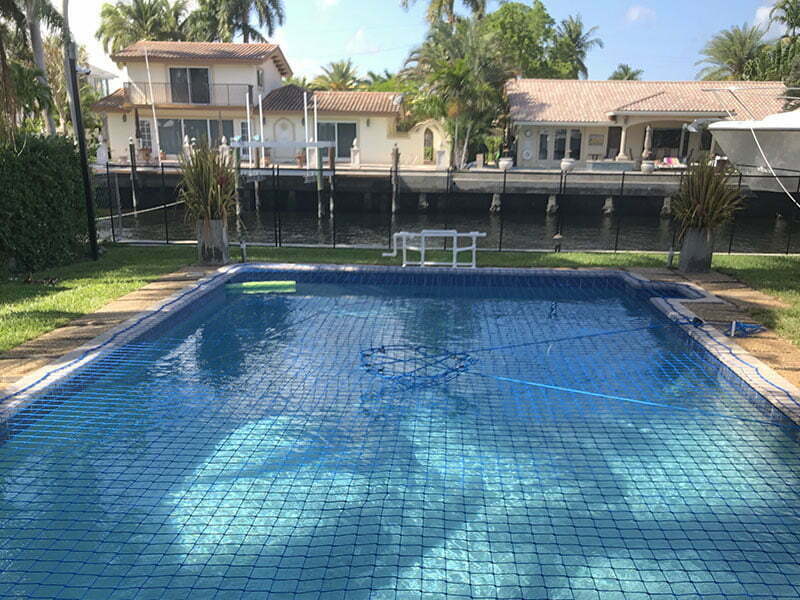
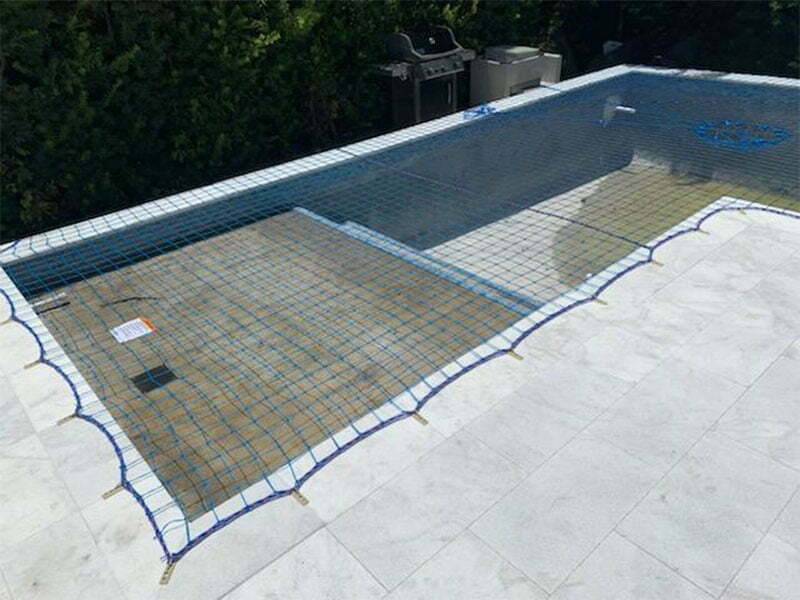
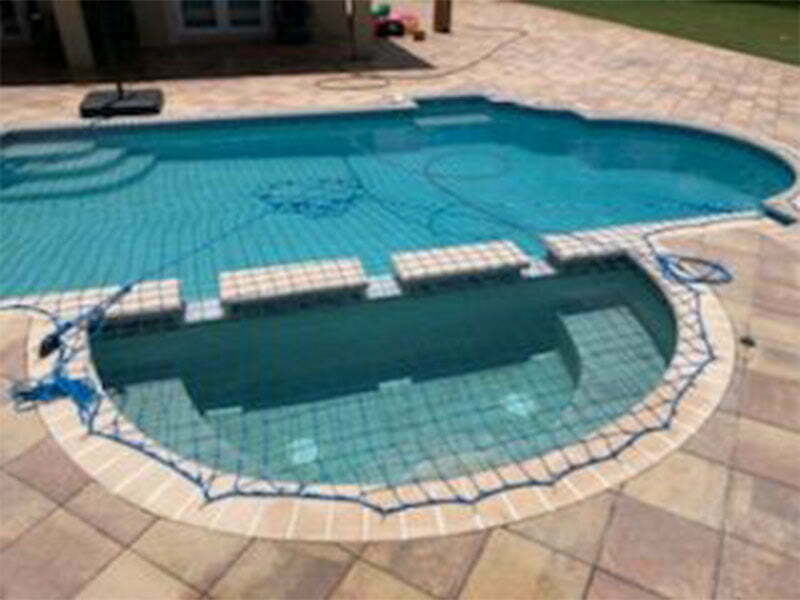
Some of Our Installed Pool Nets
Knowledge Base: Pool Safety Nets
Florida Pool Fences provides its customers with answer to questions that they may have. If you don’t see the answer to a question below, please feel free to contact us and we will get back to you as soon as we can.
Strength
The Pool Guard safety nets are made entirely with 3.5 inch nylon mesh with built-in UV stabilized inhibitors that help to maximize each net and cover’s ability to resist fading, deterioration, and shrinkage.
Pool Guard pool safety nets are ASTM certified and come with an ASTM certificate. The nets are tested to support up to 485 lbs and exceed all safety barrier requirements for the state of Florida building codes.
Yes, children’s limbs can fit through the openings, however, the net will keep the child above the water.
Installation Questions
We drill a 1 3/4 inch deep hole with a 3/4 inch drill bit.
Pool Guard Safety Net uses a flush mounted anchor that is virtually invisible should the net be removed. These anchors remain so re-installation is easily accomplished.
Generally 1 1/2 to 2 inches. When the net is being attached to a circle or arch often the anchors will be located closer to each other.
Time
Approximately 4 to 5 hours. Only a certified, authorized Pool Guard installer is permitted to install the net. Pool Guard does not use outside contractors.
Approximately 4 to 7 business days. All nets are custom sized based on the measurements of the pool.
Nets can be removed in about 5 to 6 minutes and then can be reinstalled in about 7 to 8 minutes.
Removal
Yes, the central tightening system (CTS) allows for easy removal and reinstallation by one person.
In order to not spill onto the net, you can use a funnel to add your chemicals to the pool – with a small amount of dexterity you should be able to pour chemicals into the pool and measure the chemical balance without removing the net.
Yes, we have the training and have installed nets over fish ponds, rock garden ponds, pits, and other applications that contain water features.
Other Questions
No, either choice is a fine child safety feature.
Yes, the net is designed to allow your pool vacuum to run underneath.
Pool Guard Safety Nets do not restrict your view and allow you to see your pool area, as to not interfere with your rock design or waterfall. The pool net will accommodate difficult pool designs. Pool Nets can be installed regardless of:
- ponds
- fish ponds
- rock gardens
- pools with waterfalls
- negative edge pools
- and much more