
A Walmart pool fence can look like a straightforward purchase: choose the height, buy enough footage and set aside a weekend. Then you sketch the route across your deck and discover that the last section ends beside a step, the gate crowds a walkway, or a corner lands where the surface changes.
If the kit doesn’t fit your deck, pause before cutting panels or drilling new holes. Start by checking whether the exact system can accommodate the route, surface and access points your backyard needs. Sometimes the answer is a supported layout adjustment. Sometimes a different system or a professional installation makes more sense.
This guide walks through that decision. The focus is the complete fence line: where it starts, where it turns, how it handles changes in elevation and how people will move around it every day.
At Florida Pool Fences, Randy has fielded roughly 100 calls overall from people who bought DIY pool fencing and needed help finishing or correcting the project. That is firsthand experience with DIY purchases generally, not a count of Walmart customers or a measured failure rate. A recurring reason to plan early is simple: a kit’s advertised length doesn’t tell you whether its pieces fit your particular deck.
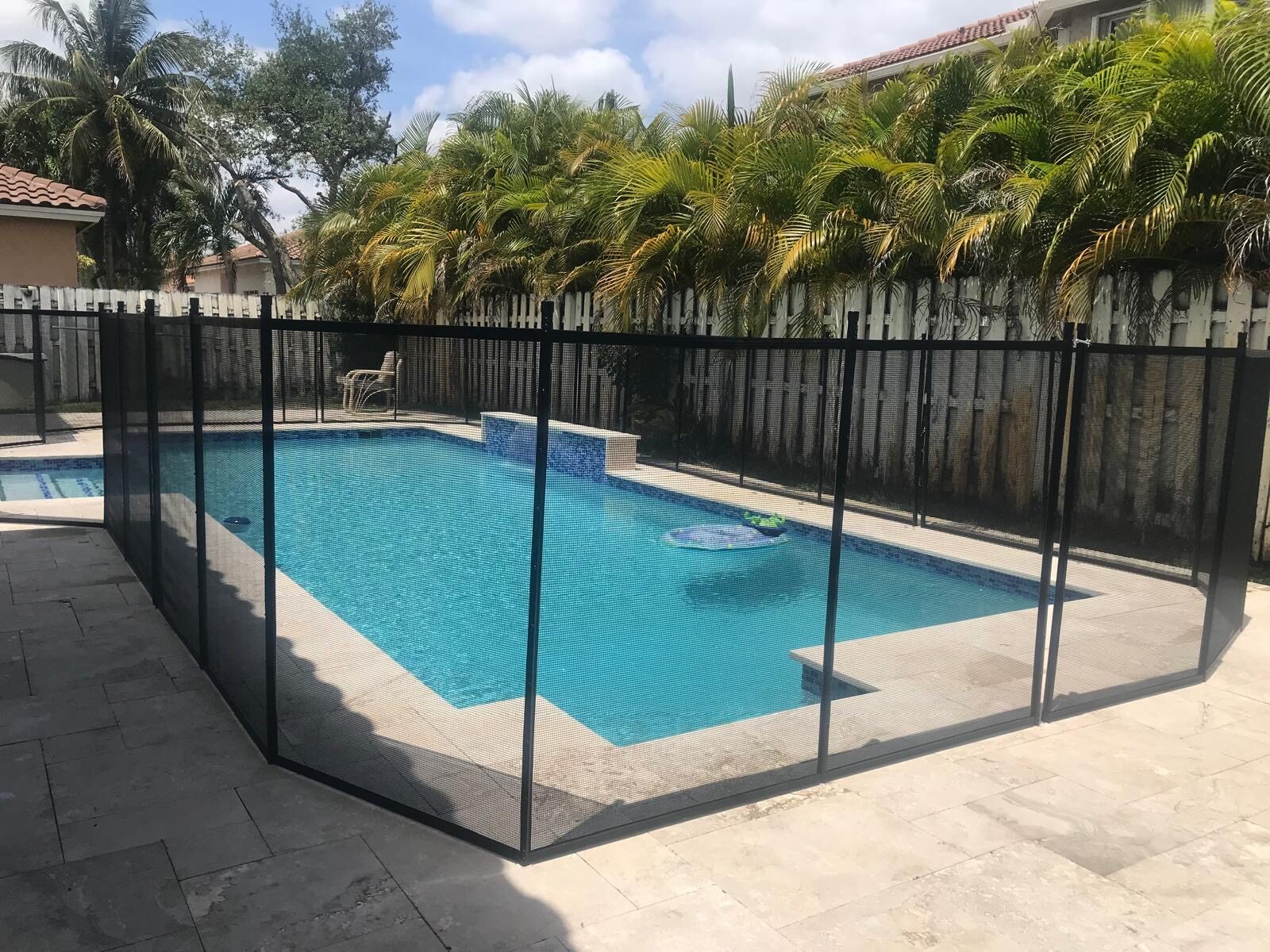
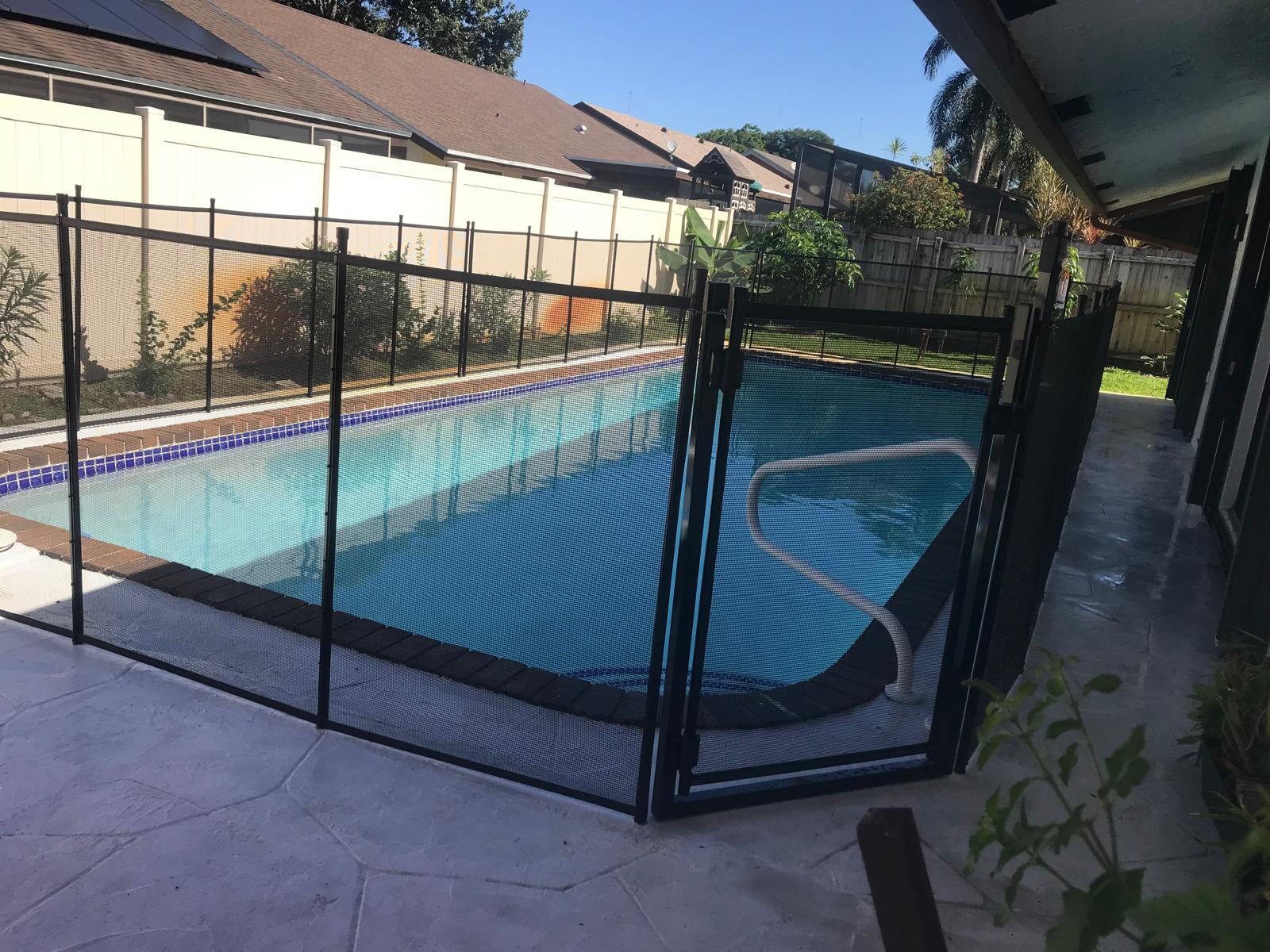
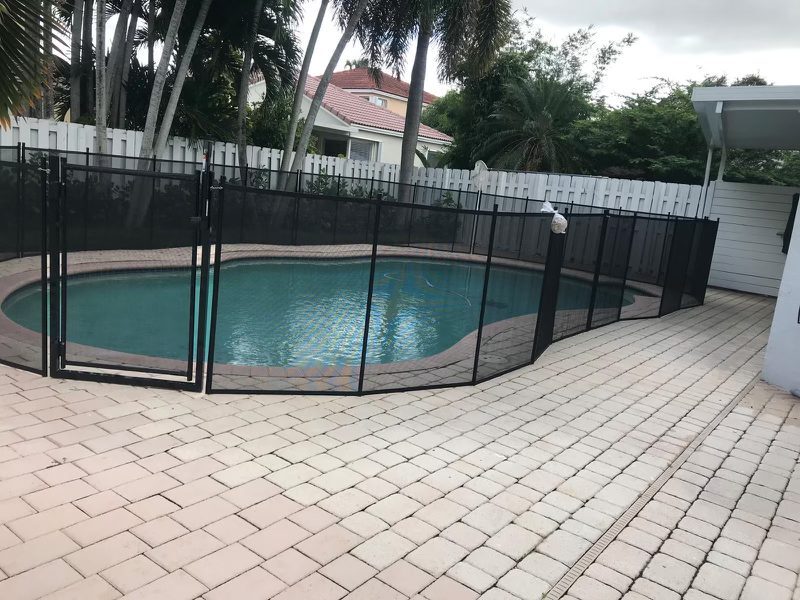
The Florida Pool Fences photographs in this article illustrate completed installations. They do not show Walmart product tests or failed DIY installations.
1. Identify the Walmart pool fence you are actually buying
Walmart is a shopping destination, not one fence design. Save the brand, exact model, seller, dimensions and installation instructions for the product you are considering. Those details matter more than a broad label such as “removable mesh pool fence.”
For a concrete example, the VEVOR 4-by-108-foot pool fence listing on Walmart describes stainless-steel legs, aluminum tubes, foot sleeves and caps, a drilling template and installation instructions. It recommends a 0.63-inch drill bit and describes compatibility with cement and concrete pavement. These are specifications for that listing, not installation instructions for every Walmart pool fence.
VEVOR also publishes a manufacturer installation manual covering layout, sleeve installation and custom cutting. The presence of a manual matters: the question is whether its supported procedures answer the conditions on your deck.
Mesh describes the barrier material. It does not establish the anchoring method. A system with metal legs or pins entering deck sleeves should not automatically be called surface-mounted. Likewise, the hole size in one listing should never become a general drilling recommendation for another product.
Before purchasing, match the instructions to the model being shipped. Ask the manufacturer about any unclear surface, step or gate detail. Save the response with the product information so you are working from one consistent plan.
2. Measure the pool fence layout, not just the pool
The fence follows a route around the water. That route may take in a wider area near a stair landing, pass around a raised spa, or leave space for a gate to swing. Measuring the water’s edge alone can miss those changes.
Draw a simple overhead sketch. Mark the pool, house doors, patio edges, steps, equipment area, planters and any fixed seating. Add the proposed fence line only after those features are visible. You do not need a polished drawing to identify a narrow passage or a corner that needs a closer look.
Break the route into separate runs and label each one. Record where the surface changes and where the grade rises or falls. Keep the measurements tied to recognizable points on the sketch rather than writing one total on a scrap of paper.
A useful pool fence layout answers three different questions:
- How much fence is needed along the proposed route?
- Where can the system’s supports and connections actually go?
- Will the enclosed area and everyday access still work?
A Walmart pool fence order based only on total footage answers the first question incompletely. Before deciding how many kits to buy, work through the other two with the exact product documentation.
3. Check where each section ends
Imagine a hypothetical layout with enough total fence in the boxes, but a final run that is shorter than a full section. The remaining panel could end beside a corner, a step or the planned gate. Extra footage by itself does not resolve that connection.
Map the individual sections onto your sketch. Mark each connection, gate position and termination point. Then identify which pieces would need shortening or another manufacturer-supported adjustment.
Some products provide a custom-cut procedure. That does not mean any cut, any replacement fastener or any improvised end connection will work. The VEVOR manual linked above includes a finishing and pole-reattachment procedure for its illustrated system. Follow the instructions supplied for your own model rather than borrowing a shortcut from a different kit.
Before modifying your Walmart pool fence, settle these questions:
- Does the manufacturer permit shortening the relevant section?
- What components and tools does the approved method require?
- Will the finished section connect where the plan needs it to?
- Have you checked the seller’s return conditions before making an irreversible modification?
Keep the packaging and model labels while you resolve fit. They help a seller, manufacturer or installer identify what you have, and they make it easier to compare an unmodified kit with another option.
4. Reserve the gate and walking route first
The most convenient place to start a fence run may be an inconvenient place to enter the pool area. Plan the access point while the rest of the route is still flexible.
Picture carrying towels from the house, moving cleaning equipment and walking past patio furniture. Check the proposed gate opening and the space its swing needs. A route that seems fine on an empty deck may feel very different after the chairs return.
Do not assume that disconnecting a removable panel is interchangeable with a gate that meets the requirements for your project. Check what the Walmart pool fence package includes, whether a compatible gate is available, and how that gate changes the layout and parts list.
Florida’s residential pool barrier statute specifies outward-opening, self-closing gates with self-latching locking devices and protected release placement. Ask your building department how the applicable requirements relate to your property and chosen system.
On the sketch, mark the gate swing as an arc. Check it against steps, walls, planters and nearby furniture. Resolve a conflict by revisiting the route or system before committing to the surrounding fence positions.
5. Give corners room to work
A corner affects the runs on both sides of it. Moving a turn to clear one obstacle can shift the next section’s endpoint or reduce the room available for the gate.
Compare the planned turn with the manufacturer’s layout instructions. Do not assume that pole spacing, orientation or support details from a straight run can be copied unchanged around every corner. Different systems address turns differently.
Look at the corner from outside the proposed enclosure as well as inside it. Is there a fixed bench nearby? Does a planter narrow the passage? Does the new direction send the next run across a deck joint or toward a surface transition?
For a Walmart pool fence that seems almost long enough, adding several small bends can create new fitting decisions even if the overall route changes only a little. Mark every bend instead of smoothing it into a rough curve on the drawing.
If your pool has a curved outline, the fence does not necessarily need to reproduce every curve. Ask what route the selected system supports and compare the resulting space around the pool. A simpler layout may be easier to evaluate, but it still needs to satisfy the manufacturer’s instructions and the project’s barrier requirements.
6. Plan a pool fence around steps and raised areas
A pool fence around steps needs more than a measurement of the upper landing. The elevation change can affect the bottom opening, the height seen from the outside, and the location of nearby climbable surfaces.
Photograph the area from both directions. Include a side view that shows the step height and the transition to the lower deck. An overhead picture alone can make a stepped surface appear almost flat.
Then ask a specific question: does this model have a supported installation detail for this change in level? If the answer is unclear, keep that part of the Walmart pool fence layout unresolved. Avoid improvising a stretched panel, an unapproved extension or a gap filler just to complete the line.
Raised spas, seat walls and built-in planters deserve the same attention. Their position relative to the outside of the barrier matters. Florida’s barrier statute addresses climbable nearby structures and openings that could allow a young child through or under the barrier.
A different route may avoid a difficult elevation change. A different system may provide a suitable detail. Have those options evaluated before treating a stepped deck as a standard flat installation.
7. Understand what supports a pool fence on pavers
In South Florida, the visible deck can include pavers, stone, tile, concrete or several finishes in the same backyard. A photo of the surface does not tell you everything about the material and support underneath it.
For a pool fence on pavers, gather any available deck information. Was the patio rebuilt? Are the pavers over a slab or another base? Does the proposed route cross a repaired area or move from one construction type to another? If you do not know, say so when requesting an evaluation.
The VEVOR Walmart listing’s reference to cement and concrete pavement should not be treated as blanket approval for every paver assembly. Ask the manufacturer whether your actual deck construction is supported and what details it requires.
Likewise, do not choose a Walmart pool fence solely because its listed hole size sounds small. The system, supporting material and approved installation method need to work together. An unsupported location can remain unsuitable even when the opening itself is narrow.
Drilling or modifying a finished deck can chip or crack some materials, depending on their condition, tools and technique. Moving holes later may also leave visible repairs. That is a reason to evaluate the surface and layout early, not a claim that every DIY installation damages a deck.
8. Walk through the layout before changing the deck
Before drilling or cutting, review the planned route on the actual deck. Use a non-damaging way to identify the line and key positions, and keep any temporary markers out of walking paths. A planning outline is not a protective barrier.
Walk from each house exit toward the proposed gate. Check the narrowest passage, the busiest corner and the equipment access route. Look for a place where someone would be tempted to leave the gate open because normal movement has become awkward.
Then check the drawing against the product list. Are all sections accounted for? Are the gate components compatible? Are connections and terminations explained by the instructions? Has anyone assumed that an existing wall or yard fence automatically completes the pool barrier?
Include the people who regularly use or maintain the backyard in this practical review. They may notice an access problem that is easy to miss while focusing on the kit dimensions.
This walkthrough does not replace manufacturer instructions, an installation assessment or an inspection. It helps uncover an inconvenient Walmart pool fence layout while changing the plan is still relatively simple.
9. Decide what to do when the kit does not fit
The boxes are still unopened
Keep them that way while you confirm compatibility. Compare a supported revised route, another product configuration and a professionally planned system. Check the actual seller’s return window and conditions rather than assuming every marketplace listing follows the same terms.
The fence is unpacked but the deck is unchanged
Inventory the pieces and keep them organized. Send the manufacturer the model information and a clearly labeled sketch of the trouble spot. A precise question about one corner or step is more useful than “Will this fit my pool?”
Some sections are already installed
Stop before extending an uncertain layout or adding more holes to make the last pieces meet. Document the installed route, uninstalled parts and any modifications. An installer may need an on-site evaluation to determine whether components or existing holes can be reused.
Do not rely on a partially installed or unresolved Walmart pool fence as a completed pool barrier. Maintain appropriate access control and close supervision while the installation is being resolved. The CPSC’s Pool Safely campaign explains the importance of using layers of protection around water.
No photo or phone conversation can guarantee that an unfinished fence is safe or that a repair will be possible. The useful next step is to identify what can be verified and what needs an in-person check.
10. Check requirements for South Florida pool fence installation
A product listing cannot determine permitting or approval for a particular property. New pool construction, an existing pool, changes to another enclosure and local rules may lead to different questions.
For South Florida pool fence installation, start with the building department responsible for the address:
- Miami-Dade County’s fences and gates guidance specifically discusses permit applications for open fences used as pool barriers. Confirm whether county or municipal staff handle your property.
- Pembroke Pines’ building forms page provides fence and swimming-pool permit checklists. Use the current checklist and ask which documents apply to your proposed work.
- Broward County’s Building Code Division identifies its service area. A Broward address alone does not mean that division is the permitting authority for your home.
Have your address, project description, proposed fence route and exact product ready when asking. Describe steps, existing walls and gates rather than asking only whether a “Walmart pool fence” is allowed.
Florida law includes requirements beyond the advertised panel height, including openings, placement and gates. Local approval is a project-specific question. Neither this guide nor a retailer’s safety wording is a substitute for that review.
11. Compare the complete installation scope
When comparing a Walmart pool fence with a professional proposal, put both options against the same drawing. Otherwise, one price may cover a box of panels while the other addresses the complete route and gate.
List the fence sections, gate and compatible hardware, tools or rentals, supported surface preparation, delivery charges, applicable permit costs and any proposed deck repair. Include only costs that actually apply to your project. Do not assume all kits include the same accessories.
Then compare who is responsible for resolving the difficult details. Who verifies the surface? Who lays out the step transition? Who checks the gate operation? What happens if the selected route cannot be installed as planned?
Ask a professional installer to explain the proposed solution in ordinary language. For South Florida pool fence installation, the most useful proposal is one you can connect to the conditions in your own backyard.
Florida Pool Fences can discuss your layout through its pool fence consultation and estimate form. Bring the model information if you already bought a kit, and explain whether anything has been cut or installed. That helps start a practical conversation about the next step.
12. Answers to common Walmart pool fence questions
Can a Walmart pool fence be shortened?
Some systems have manufacturer-supported custom-cut procedures. Check your exact model, the required finishing components and the effect on the planned connections. Do not assume another brand’s method applies.
Will a 108-foot kit fit a 108-foot route?
Total length alone does not settle section endpoints, gate requirements, turns or permitted modifications. Map the actual pieces onto the route before ordering. Do not count gate width or connectors twice when checking the package contents.
Can I install a pool fence around steps?
Possibly, but the elevation change needs a supported detail and an appropriate barrier layout. Ask the manufacturer or installer to evaluate the specific steps. An improvised opening under a panel is not an acceptable way to finish a difficult section.
Does a pool fence on pavers need a different plan?
It may. The visible pavers and the supporting construction both matter. Get a model-specific answer for the actual deck assembly rather than relying on a generic description of concrete compatibility.
Should I buy another kit if the first one does not fit?
Only after identifying what is missing. More panels can address a confirmed quantity shortage, but they may not resolve an unsupported surface, step transition or incompatible gate. Finish the layout review before spending more.
Can Florida Pool Fences help after I have started?
Contact the team with the product details, a route sketch and photographs of the installed and unfinished areas. Whether an existing kit can be completed or needs a different solution depends on the system and site. Reuse of parts or holes should be evaluated rather than promised.
A Walmart pool fence is easier to assess while the deck is unchanged and the pieces are intact. If your layout leaves unanswered questions, request a Florida Pool Fences estimate before committing to the next cut or hole.