

Pool alarms and pool fences handle different parts of the same problem: a child reaching the water when nobody expects swimming to be happening. A fence creates a physical boundary. An alarm can call attention to a door opening, someone entering a monitored area, or a disturbance in the pool, depending on the device. Used thoughtfully, those layers support each other. Neither takes over the adult's job of supervising children.
The most useful question isn't which device has the longest feature list. It's this: what happens between your back door and your pool, and where could someone get through unnoticed?
Start there, before comparing brands of pool alarms. A patio door, a side-yard entrance, a gate used by the pool cleaner, and an indoor receiver all deserve a place in the conversation. This guide explains how to put the pieces together without treating a gadget as a guarantee.
The American Academy of Pediatrics' guidance on home pools supports multiple layers and specifically says alarms aren't substitutes for a properly installed pool fence. That is the foundation for the practical planning suggestions below.
1. Give pool alarms and pool fences separate jobs
Think through an ordinary route from the kitchen to the patio. A door alert might tell you that the door opened. A separate pool fence puts a physical boundary between that patio and the water. A water-entry alarm might sound after a disturbance reaches its sensor. Pool alarms respond at different points along that route, depending on their design.
That distinction matters when shopping for pool alarms. A door sensor cannot tell you that a pool fence gate latched. A floating alarm cannot keep someone from walking through an opening. A fence cannot make an adult hear a receiver placed in the wrong room.
The CPSC Pool Safely safety tips recommend a non-climbable, four-sided fence at least four feet high, self-closing and self-latching access, and a door alarm between the house and pool area. These are safety recommendations; the requirements for your particular property need their own review.
To coordinate these pool safety layers, write down three things during a first walkthrough: what physically limits access, what might generate an alert, and who is expected to respond. If your answer to one of those questions is “I assumed the other device did that,” there's something to clarify.
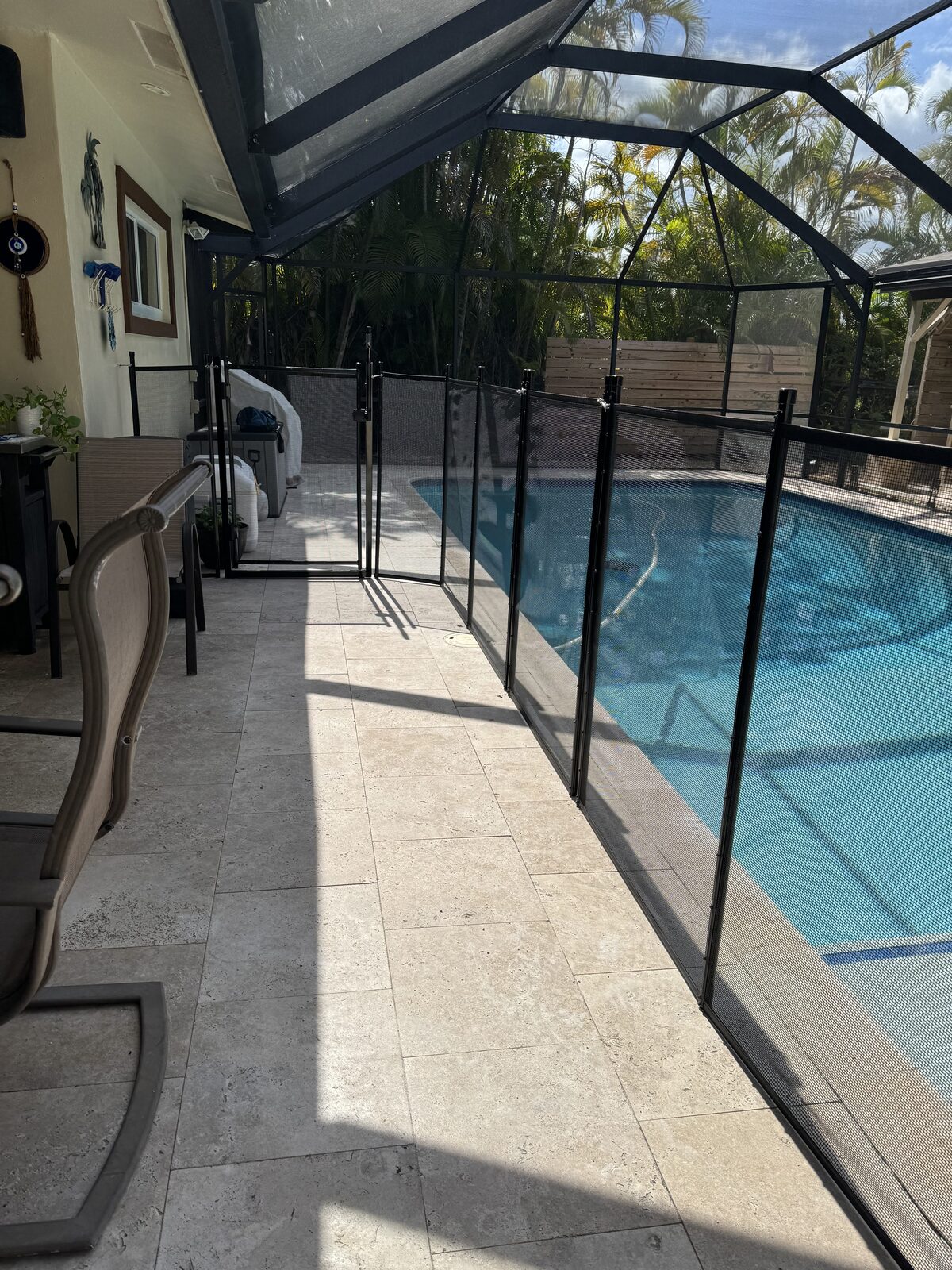
Our removable pool fence options can help you start the barrier portion of that discussion. Bring questions about how a proposed route leaves room for normal patio use, where people will pass through, and how the gate will operate. Choose the alarm around the resulting layout rather than allowing a convenient mounting location to dictate the entire plan.
2. Compare pool alarms by what they detect
The phrase “pool alarm” covers several very different devices. Read the exact model's manual, including its limitations, rather than relying on a marketplace headline. The CPSC's pool-alarm standards background identifies surface, subsurface, perimeter, and personal immersion categories. That older standards overview is useful for terminology, not a ranking of today's products.
Pool door alarms and gate sensors
These monitor an opening. They can help draw attention to access through a particular door or gate, but the details matter: what triggers the sound, whether there is a delay, how an adult passes through, and how the device returns to its active state.
Ask for a demonstration using the exact door or gate that will be monitored. A routine intended for a sliding patio door may be different from one for a pool fence gate. Also ask whether a sensor installation affects the gate hardware, closure, or manufacturer's instructions. Adding an alarm shouldn't interfere with the physical barrier it is meant to complement.
Surface and subsurface alarms
These pool alarms respond to water-related disturbances, with sensing arrangements that vary by model. The practical questions are pool size and shape, sensor placement, water level, and compatibility with the way your pool operates.
For example, the Poolguard PGRM-2 instructions explain operating water-level limits and warn that certain automatic cleaners can affect operation. Those instructions belong to that model. They aren't universal settings for every pool alarm.
The AAP also warns that a child may enter without creating enough surface disturbance to trigger an alarm. Never assume that every entry will be detected, or that silence means nobody is in the water.
Ask the manufacturer about a spa spillover, water feature, shallow ledge, cover, or cleaner before purchasing. Give a useful description of your pool instead of asking only, “Will this work outside?” A drawing or wide photograph can make the question much clearer.
Wearable immersion alarms
A wearable system depends on a sensor being worn and used correctly. That immediately creates a household question: who checks that it is actually on, functioning, and within the system's operating conditions? It cannot monitor a visitor who isn't wearing the required sensor.
Treat a wearable as its own category when comparing products. Don't assume it watches the pool itself or covers everyone who comes through the yard. Ask the manufacturer to explain the required receiver, battery checks, testing, and limitations for the specific system under consideration.
Camera-based alerts
A camera system may monitor a defined area rather than detect a disturbance in the water. Its field of view, setup, electrical supply, and connectivity deserve attention. “AI” on the box doesn't answer those questions.
The SwamCam camera-system manual describes motion-zone settings and warns about technological limitations, including power or Wi-Fi interruptions. It also makes clear that the system supplements active human supervision. Ask which local and phone alerts work under each failure condition for the particular equipment you are buying.
A general security camera with a motion notification should not automatically be treated as a purpose-designed pool alarm. Verify the device's intended use and documentation.
3. Walk every route to the water
Installing pool alarms at the most obvious openings can leave you feeling organized before you've considered the rest of the property. Take a slow walk from the places people actually spend time: the kitchen, family room, guest bedroom, garage, and side yard. Which routes eventually lead to the pool?
Make a simple sketch. Mark each opening and the proposed fence line. Next to each alarm, write what it monitors. Use plain labels such as “patio door opening” or “camera zone,” rather than drawing a circle around the whole backyard and calling it covered.
Now consider an ordinary service visit. Where does the cleaner enter? Does a delivery path cross the pool area? Would someone need to carry equipment through the fence gate? These are planning questions, not reasons to leave a gate open. Discuss access with the installer and people who regularly work at the house.
If you already have a fence, include its current condition when discussing pool alarms. An alarm purchase should not postpone attention to a gate that doesn't close or a section that has been removed. Have the barrier evaluated and address the physical problem.
Households also change. Grandchildren may visit for a weekend. A guest may sleep in a room with a different patio door. The route you use every day may not be the route a visitor discovers. Add those possibilities to your sketch without pretending any checklist can predict everything.
The result should be a layout you can explain to another adult in a few sentences. If it takes a long technical explanation to identify which gate must be closed and where an alert comes from, simplify the household instructions.
4. Make pool alarms useful inside the house
With pool alarms, a sound at the water and an alert reaching the responsible adult are separate issues. Before deciding where a receiver belongs, ask the manufacturer how to test the complete system under its instructions.
Pool Patrol's troubleshooting guidance identifies receiver placement, signal obstructions, batteries, and water disturbances among issues that can affect its equipment. Those examples are a reminder to evaluate the installation in your own house, rather than assume a distance printed on a package describes every wall and room.
Our practical suggestion is to write down where adults normally are when the pool is closed: perhaps a bedroom, home office, or kitchen. During a controlled manufacturer-approved test, check the actual alert in those locations. Keep children supervised and away from the testing area. Never use a child or pet as the test subject.
For app-based products, ask what happens if the phone is charging in another room, notifications are silenced, or the network is unavailable. Get answers for the specific model. Don't assume an indoor siren, phone notification, and camera all share the same connection or backup behavior.
Also decide what the sound means in your household. A visitor shouldn't need to guess whether a tone is a low-battery warning, a door event, or a pool alert. Have the manufacturer or installer explain those distinctions, and keep a short reference with the product instructions.
Avoid making the plan depend on someone away from home noticing a phone notification. The practical question is who can respond at the property. Remote features may be useful, but they don't create an on-site caregiver.
5. Plan for swimming, visitors, and service days
Day-to-day use of pool alarms is where a complicated setup can become confusing. An alarm may have a swimming mode or require removal during use. Another may automatically rearm under particular conditions. Check the actual manual; do not carry habits from a different model into a new one.
For instance, Poolguard's published PGRM-2 care instructions call for removing that pool unit when the pool is being used and describe testing before use. If you choose that system, learn its full procedure. The important takeaway for any purchase is to understand both the swimming routine and the return-to-monitoring routine.
Write a short close-up checklist that fits your equipment. It might include confirming everyone is out of the pool area, securing the fence access, restoring the alarm according to its instructions, and checking that the intended operating indication appears. Those are suggested checklist topics, not a substitute for the device manual.
Give the last adult finishing pool time clear responsibility for that close-up, including the pool alarms. “Someone will do it” is difficult to verify. A quick verbal handoff between adults is easier to understand than an assumption that the person carrying the towels also reset every device.
For visitors, demonstrate the gate before the gathering starts. Show the adult who is supervising how to recognize the alarm's normal operating state and who to contact if something seems wrong. Don't hand over a stack of manuals at the moment everyone wants to get into the water.
For service visits, discuss the agreed access route in advance. After work, check the affected area and equipment. If a gate, fence section, sensor, or camera position was changed, have the relevant professional resolve it before relying on the previous arrangement.
6. Troubleshoot pool alarms that keep sounding
Repeated alerts from pool alarms deserve attention. Turning a system down until it stops making noise may also change what it detects. Follow the manufacturer's troubleshooting and testing procedure, and ask for help when the cause isn't clear.
For pool alarm maintenance, keep a brief log rather than making several adjustments at once. Record the time, which device sounded, whether the pump or a water feature was running, and any visible condition that may help the manufacturer diagnose the issue. You are collecting clues, not deciding that weather automatically caused the alert.
Pool Patrol's sensitivity guidance specifically pairs adjustment with retesting. That principle makes the follow-through important: a quieter device alone does not demonstrate that the problem has been solved.
If a camera repeatedly detects movement outside the intended area, ask how its zone should be configured without excluding an access route you meant to monitor. If a door sensor is unreliable, ask whether its alignment, mounting, or the door itself needs attention. Use the relevant product's guidance rather than copying another brand's repair advice.
While an alarm is out of service, don't treat it as an active layer. Maintain the barrier and close supervision, and contact the manufacturer or qualified service provider about repair or replacement. Be equally clear with other adults in the household about what is and isn't functioning.
Save the model name, manual, purchase record, and support contact somewhere accessible. A short record of settings and testing dates can make a later support call far more productive than trying to remember what changed months earlier.
7. Review pool alarms after backyard changes
Pool alarms and pool fences should be considered together after work changes the backyard. A new deck, moved furniture, replacement gate, altered water feature, or relocated receiver is a reason to revisit the relevant instructions and layout.
You don't need to become an alarm technician. You do need to tell the appropriate professional what changed. “We replaced the router” is useful information for a connected system. “The pool water is lower while repairs are underway” matters to equipment with operating water-level limits. “The fence moved” matters to an area a camera was configured to watch.
For the barrier itself, inspect the arrangement with your installer when changes affect it. Ask about the route, access point, and any nearby objects that could affect its use. Our Florida pool fence laws guide provides separate background on the regulatory discussion. Confirm project-specific requirements with the local building department and responsible professionals; this article isn't a permit determination.
Make the household routine part of the handover, too. If one adult orders an alarm and another handles most swimming time, both need to learn the operation. Keep the instructions with the equipment information rather than buried in the purchaser's inbox.
The best time to discover a confusing setting is during a planned demonstration with the manufacturer's directions in hand. Resolve questions before treating that feature as part of your everyday safety arrangement.
Questions about pool alarms and fences
Do I still need a fence if an alarm sounds when someone enters the pool?
A water-entry alert does not physically limit access. The AAP advises that alarms are not substitutes for a properly installed fence. Consider the physical barrier and alert system together, and have the applicable requirements for your property confirmed separately.
Can one alarm protect every part of an unusual-shaped pool?
Don't assume so. Give the manufacturer the dimensions, shape, and relevant features and ask for its installation and test requirements. A purchase decision should be based on that model's documented coverage and suitability, not simply the description “for residential pools.”
Is a wearable alarm enough for a visiting child?
Wearable pool alarms do not remove the need for supervision or barriers. Their operation also depends on the required sensor being worn and used correctly. Discuss the complete setup with the child's responsible adult rather than assuming everyone understands the equipment.
Should I buy the alarm before the fence installation?
You can research pool alarms and the proposed fence together. Before purchasing, confirm that the proposed sensor locations, gate hardware, and fence layout work together. Share the product instructions with the people doing the installation so they can identify a conflict before holes are drilled or hardware is mounted.
What if the alarm is quiet during a test?
Follow the manufacturer's troubleshooting process and don't count the device as working until the required testing is successful. A quiet result is something to investigate, not a reason to assume a different entry into the water would be detected.
Does a high-tech system mean adults can supervise from indoors?
No. Pool Safely recommends an attentive adult Water Watcher whenever children are in or near water. Keep the caregiver's responsibilities separate from the equipment. An app view does not replace that role.
Put a practical fence plan beside your alarm plan
If you're comparing pool alarms and pool fences for your South Florida home, start with the yard you actually use. Bring a few clear photographs, a rough layout, and the alarm model you're considering. Tell us where you normally walk, where guests enter, and what changes you have planned for the patio.
Florida Pool Fences can discuss the fence portion of that plan and the available pool fence options. For alarm selection and technical settings, use the manufacturer's documentation and support. Keeping those responsibilities clear makes the conversation more useful.
Request a free estimate from Florida Pool Fences to talk through the barrier layout. The goal is a fence you understand, an alert system whose limitations you know, and a household routine that adults can follow consistently.