

You finish connecting the last section of your Lowe’s pool fence, step back, and notice a dip in the mesh. One side looks reasonably straight. The corner looks soft. Near the gate, the fence pulls in a different direction.
If you’re shopping for a Lowe’s pool fence, this is worth thinking through before installation. A removable mesh fence depends on the relationship between its layout, pole positions, connections and supporting surface. Buying enough fence to surround the pool doesn’t settle those details.
A loose section can have more than one explanation. Pulling harder, moving a latch or adding another hole without understanding the cause can leave you with a second problem to solve.
At Florida Pool Fences, Randy has fielded roughly 100 calls overall from DIY pool fence buyers who got stuck and needed professional help. Those calls involved DIY purchases generally; they aren’t a count of Lowe’s customers or a measured failure rate. What they underline is the value of planning the installation before making permanent changes to a pool deck.
Here’s how to think about mesh tension, what to check before buying a kit, and when it makes sense to have an installer evaluate the job. A successful DIY pool fence installation starts with understanding the complete system before choosing where to drill.
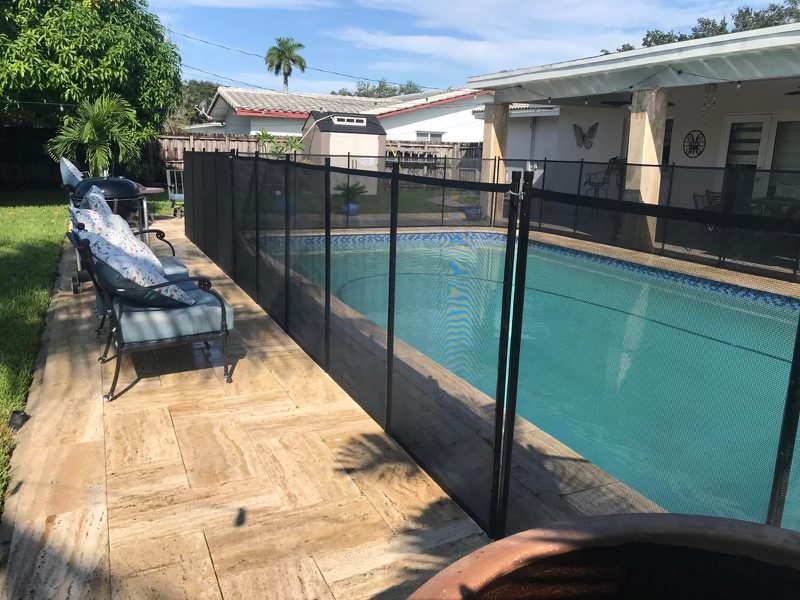
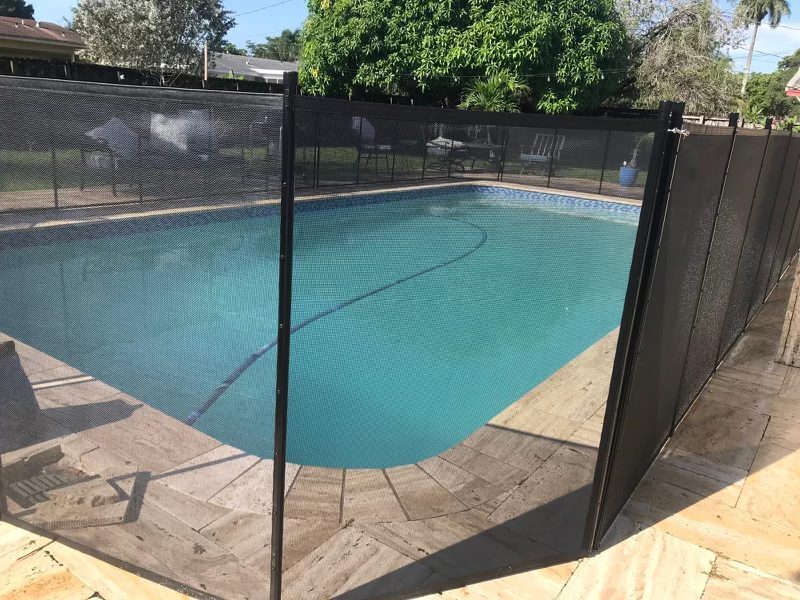
The photographs in this guide show completed installations for illustration. They are not retailer product tests or examples of failed DIY work.
1. First identify which Lowe’s pool fence you’re considering
Lowe’s is a retailer carrying different brands and fence designs. “A pool fence from Lowe’s” doesn’t identify one installation method.
For example, Lowe’s lists the WaterWarden WWF200 4-foot-by-12-foot mesh panel. The listing describes a stainless-steel anchoring pin at the bottom of the pole and small drilled holes in the deck. It also lists the SVOPES 4-foot-by-12-foot mesh system, with sleeves, caps and a drilling template. Check the current model, included components and availability before ordering.
“Mesh” describes the barrier material. It doesn’t tell you how the pole is supported. A mesh fence can use a pin-style anchoring design. A pin that enters a drilled deck hole also shouldn’t automatically be described as a surface-mounted fence.
Keep removable mesh systems separate from rigid aluminum perimeter fencing and fencing intended to attach to an above-ground pool. Photos can look similar at a glance while the components, supporting structure and installation requirements differ substantially.
Before comparing Lowe’s pool fence prices, get the exact model number and its current instructions. Make sure the manufacturer supports your proposed surface and layout. If the seller can’t provide the installation documentation you need, resolve that before purchasing.
Keep the product information together while planning: the model number, current manual, proposed gate components, surface requirements and a sketch of the route. If the manual and the retailer’s description appear inconsistent, ask the manufacturer to resolve the difference. An unanswered compatibility question should stay on your checklist until you have a usable answer.
2. What a loose mesh pool fence can tell you
Treat a visible sag in a Lowe’s pool fence as a reason to investigate, rather than a diagnosis by itself. The location and pattern give an installer useful information, but a photo alone can’t establish that a pool barrier is safe.
One panel looks loose between two otherwise consistent sections
Start by identifying that panel’s position in the original layout. Was it shortened? Was it moved from another part of the fence? Does it contain a pole that isn’t seated like the others?
The aim is to narrow down what changed. A modified panel, an assembly issue and a misplaced support may produce similar-looking symptoms, but they don’t necessarily have the same remedy. Keep the model instructions nearby and avoid trimming more material as an experiment. When describing a loose mesh pool fence to an installer, explain when you first noticed the change and whether it appeared before or after the sections were connected.
Slack appears where the fence changes direction
A corner asks the installation to do something a straight run doesn’t: carry the fence around a turn while maintaining the intended tension and orientation.
This is where measuring only the distance between marks can miss part of the job. The direction the mesh leaves each pole matters too. An installer needs to look at both sides of the turn, how the mesh is attached and how the poles relate to the finished fence line.
Several sections lean or feel inconsistent
Widespread movement calls for a broader review of the layout and support. Before assuming the mesh itself is the problem, have the pole seating, sleeves, deck condition and connections evaluated against the requirements for that system.
Don’t test a questionable fence by having a child push, pull or climb on it. Keep children away from the pool and don’t rely on the questionable barrier until the issue is resolved. CPSC’s Pool Safely guidance emphasizes barriers alongside close adult supervision and other layers of protection.
3. The measurement that matters is the installed fence line
Ordering a Lowe’s pool fence starts with total footage. Installation requires a much more detailed plan.
You need to know where the gate will sit, where sections connect, where the fence changes direction and where a full-length section won’t fit. Each of those decisions affects the nearby pole positions.
Consider a proposed fence that passes a curved pool edge, turns beside a planter and ends at a wall. That’s an illustration, not a customer case. A single perimeter measurement tells you approximately how much material the route consumes. It doesn’t tell you how to finish the wall connection, handle the turn or fit the gate into the usable deck space.
At the layout stage, ask:
- Can adults use the planned gate without an awkward approach?
- Does the route leave practical access for pool care?
- Where do the deck surface, elevation or supporting conditions change?
- Are the end connections part of the manufacturer’s approved system?
- Which sections need custom fitting?
- Can the complete route meet the requirements applicable to the property?
Moving a planned corner before drilling is usually a simpler decision than trying to make a finished fence accommodate a corner that wasn’t planned well. Walk the complete route before committing to individual holes.
4. Why copying straight-run spacing around a corner can disappoint
Randy’s installation experience includes a detail DIY buyers may overlook: straight runs and corners aren’t always laid out with identical spacing. Some corner arrangements require a longer span to produce the intended fit, depending on the system and the way the mesh travels around the pole.
That isn’t a direction to increase every corner measurement. There’s no universal extra distance that belongs in every Lowe’s pool fence installation.
The important distinction is between repeating a familiar measurement and using the correct measurement for that particular position. A straight section, a turn, a section connection and a gate connection may each call for different treatment.
Pole orientation is part of that calculation. Where a pole has a molding or attachment strip holding the mesh, its rotation changes the direction in which the material leaves the pole. A pole can stand in the intended spot while its attachment face is poorly oriented for the route.
This helps explain why a fence may look acceptable down one side of the pool and become awkward at the next turn. The physical fence has to follow the layout in three dimensions. A series of evenly spaced marks is only part of the information needed.
Have the manufacturer or an experienced installer clarify any corner detail that doesn’t match the instructions. Guessing at spacing and then trying to compensate with extra pull is a poor way to settle it.
5. Follow the drilling instructions for your Lowe’s pool fence
The direction of the hole can influence where the top of the installed pole sits under tension. For systems that call for it, an appropriate outward angle at a turn is part of the installation design.
The appropriate direction and amount depend on the product, position and layout. A rule taken from another brand, a short video or a different corner on the same property may be the wrong rule for the hole in front of you.
Manufacturers do publish useful guidance. The Sentry Visi-Guard and EZ-Guard manual hosted by Lowe’s distinguishes straight runs, turns, section ends and gate supports. It also explains that the sections must be connected before the intended upper tension is achieved. Those are instructions for the named Sentry products, not specifications for every brand Lowe’s carries.
Separately, Pool Fence DIY’s installation library includes layout, drilling, turns, steps and different deck surfaces. That’s a useful example of detailed manufacturer support; it isn’t a claim that Lowe’s sells that system or that its instructions apply to another kit.
Read the complete instructions for the exact fence before starting. If the plan requires a detail they don’t clearly address, get an answer before drilling. Professional judgment matters most where the actual deck doesn’t match the simple example in a guide.
6. Plan the gate before tightening the surrounding fence
For a Lowe’s pool fence installation, the gate needs a workable position, stable support and the clearances specified for its system. It also needs to operate correctly after the adjoining fence is connected.
Suppose the mesh appears loose near the opening. Pulling that section harder may seem like an obvious improvement. Before doing so, determine whether the problem involves the mesh, the support position, the connection or the gate layout. An adjustment that makes a panel look straighter isn’t successful if it interferes with the gate’s operation.
Check what the kit actually includes. A place where two sections can be manually disconnected isn’t the same assembly as a hinged, self-closing, self-latching gate. Include the appropriate gate and its required components when comparing complete project costs.
After installation, gate operation needs to be checked according to the manufacturer’s instructions and applicable requirements. It should not need an adult to remember to pull it shut each time. CPSC recommends self-closing, self-latching gates as part of a pool barrier. Product selection and installation still need to fit the property’s local requirements.
7. A similar-looking deck may need a different installation plan
Before installing a Lowe’s pool fence, look beyond the visible deck finish. From above, two pool decks can appear nearly identical. The structure beneath the surface may be different.
Concrete, pavers, tile over a supporting surface, wood and soil areas shouldn’t be treated as interchangeable mounting conditions. A kit’s template helps with its intended layout; it doesn’t identify everything beneath a mark on your deck.
Before drilling, establish what the surface is, what supports it, and whether the manufacturer has an approved installation method for those conditions. Existing cracks, edges, joints, transitions and nearby equipment can also influence the proposed route.
Randy has also heard from DIY customers who cracked a deck while using a hammer drill. That does not mean every hammer-drill installation damages a deck; some manufacturers specify that tool. It does mean the tool, supporting surface and technique need to suit the actual job. If you are unsure, getting advice before drilling is a sensible precaution.
If the structure or concealed services are uncertain, stop and get qualified help identifying them. Don’t assume that a method shown on a concrete slab is appropriate for a raised deck, and don’t drill through an unexpected obstruction to keep the project moving.
Our Florida pool fence installation overview explains how an on-site evaluation and layout planning fit into a professional installation. The dimensions and techniques for our system shouldn’t be copied into a different manufacturer’s kit.
8. Already installed it? Gather these details before attempting a fix
If your Lowe’s pool fence is already installed, you can make a professional assessment more productive without altering the fence again.
- Identify the product. Find the brand, model number, purchase information and instructions supplied with the fence.
- Photograph the whole route. Include both sides of the questionable area, the nearest turn and the gate. Close-ups alone can hide the layout.
- Record what changed. Note any shortened sections, relocated poles, substituted hardware or changes made after the initial installation.
- Show the supporting surface. Photograph the sleeves and deck around the affected poles without removing parts from a barrier that’s in service.
- Describe gate behavior. Explain whether it closes and latches consistently, rubs, or needs a hand to line up.
- Pause further modifications. Avoid adding holes, trimming mesh or improvising connections until the cause has been assessed.
Ask the installer whether they work on that brand and whether existing components can be evaluated for reuse. A professional may need an on-site inspection before recommending repair or replacement. Don’t assume another company’s poles, sleeves or gate parts will be compatible.
If a questionable fence is currently your pool barrier, prioritize securing access with qualified guidance. A repair appointment on the calendar doesn’t make an unreliable barrier adequate in the meantime.
9. Compare complete Lowe’s pool fence installation costs
A low section price is easy to compare. A complete installation takes a little more work to price fairly.
For the DIY option, include the required gate, connectors, surface-specific components, tools or rentals, delivery and any custom-fitting materials. Also consider whether you have the time and experience to solve the layout details your property presents.
For a professional pool fence installation quote, ask what’s included in the proposed route, gate installation, finishing work and support after completion. Request clarification on the product being installed and the scope of any warranty. A product warranty and an installer’s responsibility for workmanship are different things to understand before hiring.
DIY can be a reasonable choice for a capable homeowner using a suitable system with a clear installation plan. The risk increases when the plan relies on figuring out important measurements, support conditions or corner details after work has begun.
Getting a quote before ordering gives you a useful comparison while all your options are still open. You can weigh the cost of the kit and the work involved against having the complete installation handled for you.
Include local review in the project plan
A Lowe’s pool fence purchase does not settle the requirements for your property. Florida Statutes section 515.27 describes alternative residential pool safety features. Those alternatives do not eliminate applicable building-code or local barrier requirements. Ask your building department how the proposed system and layout should be reviewed before beginning work.
Local documentation can affect the scope of the job. For example, the Coral Springs fence and gate permit checklist requests a survey with the proposed structure and setbacks. For a pool fence, it also calls for plans showing compliance with residential swimming pool barrier requirements. Other municipalities may use a different application process.
Ask who will prepare any required documents, coordinate inspections and address review comments. Include these responsibilities when comparing DIY and professional pool fence installation. Keep the manufacturer’s documentation and the completed project records together for future maintenance, replacement parts or questions about the installation.
10. Questions homeowners ask about DIY pool fence installation
Can I tell whether my Lowe’s pool fence is tight enough by looking at it?
Appearance can flag a concern, but it can’t confirm the whole installation is correct. Pole support, connections, openings and gate function need attention too. Use the manufacturer’s checks and get a professional assessment when anything is uncertain.
Should I move the latch to take out a dip?
Only make adjustments supported by the instructions for that product. First establish why the dip is there. Moving a connection may change the appearance without correcting an underlying layout or support problem.
Can I reuse holes from a different pool fence?
Don’t assume they’ll match. Pole and sleeve dimensions, spacing, layout and the required support may differ. Have the existing holes and proposed replacement system evaluated together before buying on the assumption that everything will fit.
Does the retailer’s pool-fence category mean the kit is approved for my property?
No. Verify the exact product documentation and the requirements that apply where you live. A retail category doesn’t establish that a particular layout, gate arrangement or installation will satisfy your local authority.
What should I send when asking Florida Pool Fences for advice?
Send the model information, a description of the concern and clear photos of the whole fence route and affected area. Tell us whether the fence is already installed or still in the box. That helps us understand the job before discussing the next step.
11. Get the layout right while you still have choices
Before you buy a Lowe’s pool fence, understand how the exact system will handle your deck, turns and gate. If you’ve already started and the mesh looks loose, stop making changes until you understand the cause.
Before work starts, settle the questions that could change the route: the deck support, corner treatment, gate assembly, end connections and local review. Write down any detail that remains unresolved. If you have already installed the fence, give an assessor the same information along with photographs of the current layout and a record of modifications.
Florida Pool Fences installs removable pool safety fencing for South Florida homeowners. Request a free estimate and include pool or deck photos if you have them. We can discuss your property and the installation you’re considering before you commit to the next step.