

Pool fence Plantation guide: Start by checking how children could reach the water from your house, yard, driveway, and neighboring properties. Then confirm the barrier design and permit requirements with the city before installation. A fence works best when its layout, gate, attachment points, and everyday use are planned together.
Plantation requires residential swimming pools to have a complete safety barrier. Florida also has statewide pool safety requirements, but choosing an alarm or cover under the state safety statute does not automatically remove the physical barrier requirements that apply to your property.
This guide explains the decisions that matter before buying a fence: how the rules fit together, what to ask about permits, where the fence should go, and how to compare installation proposals. It also covers screen enclosures, attached spas, existing pools, and the maintenance that keeps a barrier working after installation.
Planning note: Requirements below were reviewed in October 2026 under the current 8th Edition (2023) Florida Building Code. Confirm the code edition and permit conditions for your specific project with Plantation before work begins.
1. Pool fence Plantation: understand the requirements
Plantation pool fence requirements come from more than one source. The Florida Residential Swimming Pool Safety Act addresses residential pool safety features. The Florida Building Code governs construction. Plantation’s municipal code adds local pool and barrier provisions. Your approved plans and inspection requirements connect those rules to your actual property.
How the state safety options fit together
Florida Statutes Section 515.27 lists five alternative safety features: an isolation barrier, an approved safety cover, qualifying alarms on doors and windows, qualifying self-closing and self-latching doors, or a qualifying pool-entry alarm. Each option has its own conditions. An ordinary door chime or floating toy does not become an approved safety device simply because it makes noise.
Meeting that statute is only one part of compliance. Do not assume an alarm alone satisfies every building-code or municipal barrier requirement. Ask the building department to review the complete safety arrangement, particularly when a house wall or screen enclosure forms part of the perimeter.
What the Plantation pool barrier code adds
Plantation Code Section 5-40 requires a complete pool barrier using a screen enclosure, fence, wall, or permitted combination. Its provisions also address existing pools and keeping barriers in good repair. Buying a house with an older pool is a reason to inspect the current barrier, rather than assume its age settles the issue.
The state’s residential pool barrier requirements include a minimum outside height of four feet, protection against climbing or squeezing through, and gates that open away from the pool and close and latch themselves. Gate-release placement must prevent access by young children. The applicable building code and approved design add details that a height measurement alone cannot establish.
For a broader explanation, read our guide to Florida pool fence laws. For a property-specific answer, provide the city with a layout showing every door, window, gate, and barrier connection.
2. Confirm permits and prepare your documents
Resolve the permit question before ordering materials or drilling the deck. Under Plantation Code Section 5-38, pool and barrier permitting are coordinated; an existing barrier may be accepted when inspected and found satisfactory. For a standalone fence installation, replacement, or layout change, ask the city which application and inspections apply to the proposed work.
Describe the project accurately. A removable mesh fence inside an existing screen enclosure, a new property-line fence, and a structural screen-enclosure replacement are different jobs. The city needs the proposed scope to tell you what to submit. Calling a fence removable does not establish a permit exemption.
Pool fence Plantation: permit checklist
- Property information: The address, available survey, pool location, and existing barrier layout.
- Proposed layout: Fence runs, gate locations, attachment points, and any openings from the home.
- Product information: The fence and gate models, installation instructions, and relevant compliance documentation.
- Site conditions: Deck material, steps, changes in elevation, existing structures, and planned resurfacing.
- Responsibilities: Who submits the application, answers plan-review questions, schedules inspections, and closes the permit.
The city’s screen-enclosure checklist calls for items including a permit application, recent survey, signed and sealed engineering, safety affidavit, and barrier information. It is useful when enclosure work is involved, but should not be treated as the application checklist for every mesh-fence project. Additional drainage approval may apply in Plantation Acres.
Check the date on permit documents: Plantation repealed its former pool performance-bond provision in Section 5-39 on February 11, 2026. An older checklist may still mention that bond. Confirm the current submission requirements with the city rather than treating an older form as the final word.
If an association reviews exterior changes, check its requirements early. Association approval and city approval are separate steps. Submit the same fence layout to both so a later change does not leave your documents describing different projects.
Keep approved plans, inspection records, product instructions, and warranty information together. Those records are useful when replacing a gate, resurfacing the deck, selling the home, or checking whether a later modification still matches the approved barrier.
3. Plan a complete barrier around your pool
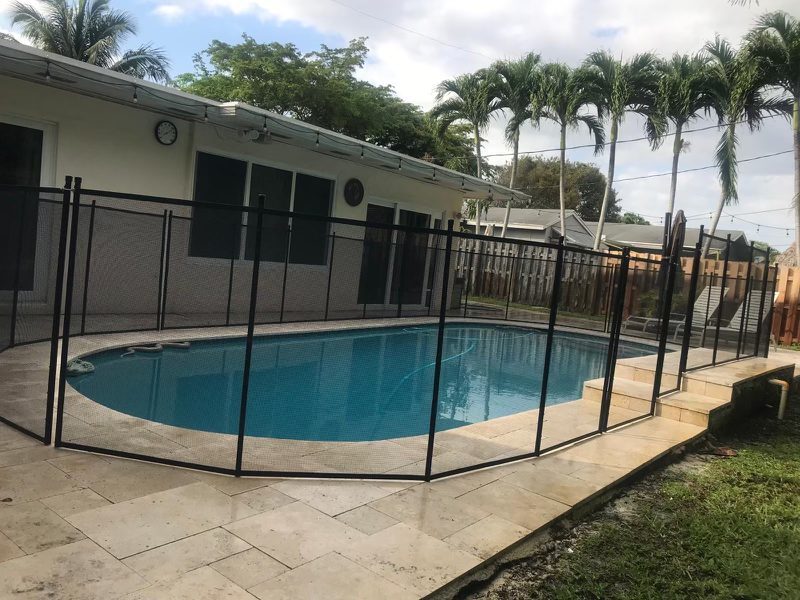
Walk the proposed fence line before focusing on its color or price. Start at every door leading outside and follow the routes a child could take toward the water. Include side yards, garage access, screen doors, low walls, and any opening beside equipment. A short unprotected route can undermine an otherwise well-built fence.
A four-sided isolation layout separates the pool from both the home and the surrounding yard. The Florida Department of Health’s layers-of-protection guidance recommends four-sided fencing with self-closing, self-latching gates alongside other protective measures. It is a useful starting point when comparing layouts, even when your approved plan permits another configuration.
Fit the barrier to the pool and the way you use the yard
- Freeform pools: Compare several straight fence runs with tighter changes in direction. Following every curve can consume usable deck space and add installation complexity.
- Rectangular pools: Check whether a simple layout preserves a practical walking route without placing the barrier too close to the water.
- Attached spas: Include the spa in the protected area and look carefully at raised edges, spillways, and nearby walls.
- Small decks: Test the proposed gate swing and everyday access before committing to anchor locations.
- Larger properties: Decide which parts of the yard should remain accessible without entering the pool enclosure.
Place the main gate where adults will naturally use it. An awkward route encourages shortcuts, including propping the gate open. Consider access for pool cleaning, equipment service, and carrying ordinary outdoor items. Discuss accessibility needs with the installer before the layout is finalized.
Move chairs, storage boxes, planters, and other climbable items away from the outside of the barrier. Consider what happens when furniture is rearranged for guests. A layout that depends on one chair staying in exactly the right place needs another look.
Before approving the design, have the installer explain each endpoint. Connections to walls, columns, existing fencing, and changes in deck elevation should form a continuous barrier without a bypass route.
4. Choose a mesh fence and a dependable gate
Removable mesh pool fence Plantation: compare the complete system
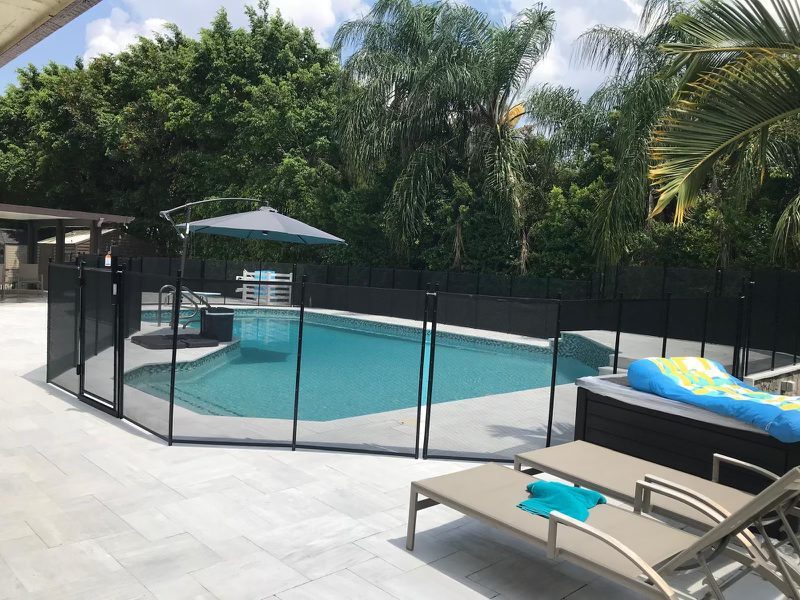
When choosing a removable mesh fence, start with the complete system. Mesh, poles, deck sleeves, fasteners, connections, and gate hardware must work together. A product description saying “pool safe” provides much less useful information than a documented model and installation method.
Mesh allows visibility across the yard and can make it easier to see the water from nearby areas. Visibility still depends on lighting, viewing angle, furniture, and landscaping. Seeing through a fence does not replace being close enough to supervise a child in the water.
Questions to ask about the fence system
- What height and model are included in this proposal?
- What documentation addresses ASTM F2286 and the requirements applicable to this installation?
- How will the system be anchored in this particular deck?
- How are corners, wall connections, and elevation changes handled?
- Which replacement parts are available, and who supplies them?
- What care, inspection, and reinstallation instructions will the homeowner receive?
Request the manufacturer’s instructions and have the installer explain how the proposed work follows them. A system’s performance depends on its installation; mixing components or improvising attachment details can change how the finished fence behaves. Confirm the city’s acceptance of the product and configuration where required.
Pool fence Plantation: gate checks
A gate needs enough clearance to operate without rubbing against the deck, landscaping, or furniture. Ask for a demonstration of its self-closing and self-latching operation from different opening positions, following the manufacturer’s instructions. Watch the latch engage rather than judging only by the sound of the gate closing.
Latch height and placement must match the applicable requirements and approved configuration. Avoid relying on a single universal latch-height claim. Also, a section that an adult can manually unhook is not automatically a substitute for a compliant everyday access gate.
Our pool fence options page is a starting point for comparing systems. Bring the questions above to the site visit so the discussion covers how the fence will function in your yard.
5. Check screen enclosures and other safety options
A screened pool area needs a careful access review. An enclosure may form part of an approved barrier, but its presence alone does not establish compliance. Look at every screen door, damaged panel, wall connection, and route from the house. A home door opening directly into the enclosure can give a child access to the water without crossing an interior fence.
An isolation fence inside the enclosure can create a separate pool zone. That arrangement may allow adults to use part of the screened patio while keeping the water behind a controlled gate. The fence line still needs appropriate endpoints and enough room for the gate to work.
For examples of the issues to check, read pool fences with screen enclosures in Florida. If structural enclosure work is planned, coordinate the two projects before anchors or framing are placed.
Compare covers and nets by their actual use requirements
An approved safety cover has specific performance requirements. A solar blanket, ordinary tarp, or debris cover should not be assumed to provide the same protection. Ask for documentation for the exact model and confirm whether it fits the pool, attached spa, raised features, and proposed compliance plan.
Before choosing a cover or net, ask the installer to demonstrate the whole removal and replacement process. Consider who will secure it after every swim, where it will be stored, and whether that person can operate it correctly. A safety product provides no protection while it is off the pool.
You can compare our pool safety covers and pool safety nets, but confirm the specific product’s role with the city. A net should not be assumed to qualify as the approved safety-cover option or to replace a required barrier.
Door alarms and pool alarms can provide additional warning. Include battery checks, testing, and instructions for caregivers in the household routine. Choose layers that adults will consistently use, and keep the physical barrier in working order.
6. Pool fence Plantation: prepare for installation
The site assessment should happen before the final layout and price are settled. Photos can help start the discussion, but they may not show loose pavers, uneven surfaces, thin edges, hidden obstructions, or conditions around a raised spa. Tell the installer about previous deck repairs and any planned work.
Pool fence Plantation: installation checklist
Confirm the approved layout, fence height, gate location, finish, and attachment method in writing. Identify any changes since the estimate. If the deck will be resurfaced or the pool remodeled, coordinate the sequence so new sleeves and anchors do not have to be moved or replaced immediately.
Clear the work area of furniture and removable obstacles. Discuss access, pets, work hours, and how the pool area will remain protected during the job. Do not leave children with access to an unfinished barrier or assume the work crew is providing pool supervision.
During layout and drilling
Review the marked fence line before permanent holes are made. Check the proposed gate swing, usable patio space, pool-service access, and both ends of each run. If the marked layout differs from the approved plan or quote, resolve the change before proceeding.
The installer should assess whether the deck can support the specified system and use the required anchoring method. Pavers, concrete, tile, and other surfaces can call for different preparation. Point out known utilities, drainage features, and pool equipment lines so the installer can address relevant site risks.
At handover
- Walk the entire barrier and inspect the connections, tension, and deck attachments.
- Operate the gate and verify that it closes and latches as intended.
- Receive written instructions for maintenance and any permitted removal and reinstallation.
- Confirm whether an inspection remains outstanding and who will arrange it.
- Keep the invoice, product details, approved plans, and inspection documentation.
For scheduling context, see how long pool safety fence installation takes. Separate the on-site installation time from the full project schedule, which may include permitting, material availability, repairs, and inspections.
7. Pool fence Plantation: compare costs and quotes
A meaningful estimate starts with the proposed fence line, rather than the pool’s dimensions alone. Two pools with the same water area can need different fence footage, gates, and attachment details. The deck condition and existing enclosure can also affect the work.
When comparing proposals, ask each installer to price the same layout and scope. Otherwise, a lower total may reflect less fence, a different gate, excluded permit work, or an installation method that has not accounted for the site.
Pool fence Plantation: quote checklist
- Fence specification: Approximate footage, height, model, finish, and layout.
- Gate specification: Quantity, locations, dimensions, and closing and latching hardware.
- Installation scope: Deck preparation, sleeves, anchors, wall connections, and any special conditions.
- Existing materials: Whether removal, disposal, repairs, or unused-hole treatment are included.
- Permit work: Who handles required submissions and inspections, and how related fees are charged.
- Aftercare: Written warranty terms, service arrangements, and replacement-part availability.
Ask what would trigger an additional charge and how changes are approved. If the quote assumes sound concrete beneath pavers, for example, find out what happens if site inspection shows a different condition. It is easier to discuss that possibility before the work starts.
Review product and workmanship coverage separately. Ask which parts are covered, whether labor is included, what maintenance is required, and who to contact for a gate that stops latching. Keep the written terms rather than relying on a general claim about durability.
There is no reliable single price for every Plantation installation. A site-specific estimate should explain the proposed solution well enough that you can compare both the initial cost and the practical responsibilities of owning it. Avoid choosing a layout solely to save a few feet if it creates inconvenient access or leaves a route to the pool unresolved.
8. Keep the barrier working every day
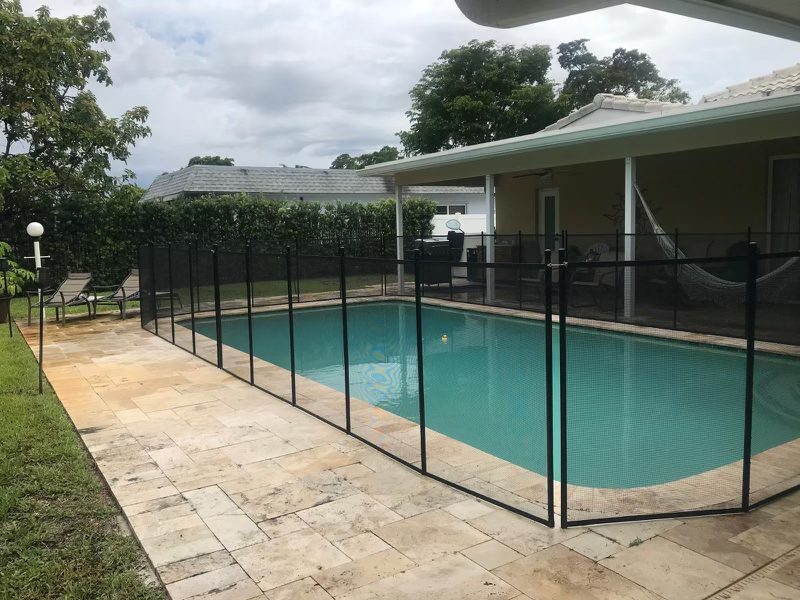
Once the fence is installed, make a short visual and gate check part of opening and closing the pool area. Look for loose connections, damaged mesh, shifted poles, and anything preventing the gate from latching. Follow the manufacturer’s inspection and maintenance schedule, and arrange repairs when a problem appears.
Keep the gate closed when the pool is not being actively used. Do not prop it open for deliveries, gardening, or pool service. Discuss access with anyone who works in the yard so the barrier is restored immediately after their work.
Pool fence Plantation: post-storm inspection
Inspect the barrier after strong weather, deck repairs, landscaping work, or moving outdoor furniture. Check for debris around the gate and new climbable objects beside the fence. If an attachment, pole, or latch is damaged, prevent unsupervised access to the pool while arranging proper repair.
Removable sections require particular care. Follow the approved design and manufacturer instructions, and do not leave the pool unprotected while children can reach the area. After reinstallation, check every connection and demonstrate the gate’s operation again. Convenience should not turn an installed barrier into a fence that is regularly left in storage.
Make supervision explicit
During swimming, assign a responsible adult to watch the children without phone use or competing tasks. At gatherings, agree who is watching and make an explicit handover when that person changes. A fence cannot protect a child who is already inside the pool area.
Keep toys out of the water when swimming ends, maintain alarms as directed, and make sure caregivers know how the gate works. Adults responsible for swimmers should learn CPR and have a plan for calling emergency services. These habits complement the fence and continue to matter as children become more confident in the water.
9. Pool fence Plantation: questions before your estimate
Do Plantation pool fence laws apply to an existing pool?
Plantation’s barrier provisions include existing residential pools and maintenance of the barrier. If you recently bought the property, inspect the present condition and ask the city about missing approvals, proposed replacements, or questionable access points. An old fence should not be assumed satisfactory simply because it came with the home.
Can an existing yard fence serve as the pool barrier?
It may form part of an approved arrangement if the entire configuration meets the applicable requirements. Check gates, openings, climbable features, and access from the house. A fence around the property boundary may still leave the pool freely accessible to a child who exits the home.
Does a mesh fence protect pets too?
Discuss the animal’s size and behavior with the installer. A child-safety barrier should not be assumed pet-proof; a pet may chew, dig, climb, or damage mesh. Check whether pet use affects the product choice or warranty, and continue supervising animals near the water.
Pool fence Plantation estimate: what should I prepare?
Have your property address, available survey, deck details, and any existing permit documents ready. Photos of the pool, gates, house doors, and proposed fence endpoints help explain the project. Mention remodeling plans, an attached spa, accessibility needs, and your preferred timing.
Florida Pool Fences serves Plantation homeowners, including Plantation Acres, Jacaranda, Lago Mar, and surrounding neighborhoods. Each estimate should address the actual property layout. A large yard and a compact screened patio need different planning, even when the same fence system is being considered.
Contact Florida Pool Fences to request a free estimate. Before installation, confirm the layout, gate, product documentation, permit responsibilities, and inspection plan. That preparation gives you a clear basis for choosing a barrier and keeping it effective after the work is finished.