
South Florida pool safety deserves attention every day of the year. World Drowning Prevention Day gives homeowners, parents, grandparents, caregivers, and anyone with access to a backyard pool a reason to stop and perform a complete safety inspection.
World Drowning Prevention Day is observed every year on July 25. It was established to focus attention on preventable drowning deaths and the practical steps communities and families can take to reduce them. The 2026 World Health Organization campaign calls on people, businesses, and public agencies to “Unite to Turn the Tide.” You can learn more on the World Health Organization’s World Drowning Prevention Day page.
For Florida families, drowning prevention is especially important because pools and other bodies of water are part of daily life throughout the year. The Florida Department of Health states that drowning is the leading cause of unintentional death among Florida children ages 1 through 4. Home swimming pools are where children in that age group are most likely to drown. Review the state’s information and resources on the Florida Department of Health drowning-prevention page.
This guide is designed as a practical South Florida pool safety inspection. Walk around the property, test every barrier, look at the pool from a child’s perspective, and make sure everyone in the home understands their responsibility.
Unintentional Drowning Deaths in South Florida in 2024
Florida Health Charts reported the following unintentional drowning deaths among people of all ages in 2024:
- Broward County: 53 deaths
- Palm Beach County: 39 deaths
- Miami-Dade County: 30 deaths
- Monroe County: 6 deaths
These numbers are not limited to children, backyard pools, or a single type of water. They are county totals based on the underlying cause of death and the county of residence. They should therefore be described as all-age unintentional drowning deaths, not child drowning deaths. The official data can be reviewed through the Florida Health Charts death-data viewer.
The purpose of sharing these statistics is not to frighten families. It is to show why pool barriers, active supervision, swimming skills, alarms, and emergency preparation all matter. Drowning prevention works best when several independent protections are in place at the same time.
Why South Florida Pool Safety Requires Several Layers
No single product or safety rule can prevent every emergency. A pool fence cannot replace supervision. Swimming lessons cannot replace a barrier. An alarm cannot replace a responsible adult. A life jacket cannot make a child drown-proof.
The Florida Department of Health recommends several layers of protection, including active supervision, barriers and alarms, emergency preparation, swimming skills, water-safety education, and properly fitted life jackets. See the full recommendations on the Florida Department of Health Layers of Protection page.
The following checklist can help homeowners evaluate the entire pool area instead of focusing on only one piece of equipment.
Complete South Florida Pool Safety Checklist
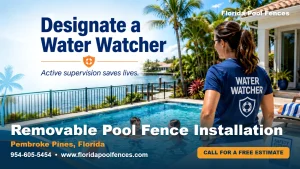
1. Designate a Water Watcher
Whenever children are in or near the water, one responsible adult should be assigned as the water watcher. That person’s only job should be watching the pool and the people around it. The water watcher should remain close enough to respond immediately and should continuously scan the water, steps, shallow areas, spa, deck, and any location where a child could enter.
A water watcher should not be checking a phone, preparing food, reading, drinking alcohol, working, talking for long periods, or assuming that another adult has taken over. In groups, responsibility can become unclear very quickly. Several adults may be present while each person believes someone else is watching.
Use a clear handoff. When one water watcher needs a break, that person should name the replacement and receive a verbal response before walking away. A wristband, tag, lanyard, or designated chair can help make the assignment visible during parties and family gatherings.
- Choose a responsible adult who can swim.
- Remove phones and other distractions.
- Keep the watcher close to the water.
- Change watchers using a clear verbal handoff.
- Never leave the position without a replacement.
The American Red Cross recommends a designated water watcher for home pools and group swimming situations. Review its home swimming-pool safety recommendations.
2. Look at the Pool From a Child’s Height
Adults usually inspect a backyard while standing. A small child sees the same space from a much lower angle. Crouch down near the home, patio doors, fence line, gate, furniture, landscaping, and pool deck. Look for anything that appears reachable, climbable, or interesting from that height.
You may notice that a chair creates a step toward a window, a planter sits close enough to help a child reach a latch, or a toy can be seen through a fence opening. A gate latch that looks high to an adult may be reachable from a bench, cooler, storage box, or decorative wall.
Perform the inspection from several locations, including the child’s bedroom, family room, patio entrance, play area, and any route connecting the house to the backyard. The goal is to identify the path a curious child might follow when no one expects the pool to be used.
- Move climbable furniture away from barriers.
- Look for gaps beneath fences and gates.
- Check whether latches can be reached using nearby objects.
- Remove attractive toys from view.
- Secure pet doors that could provide access to the pool area.

3. Inspect the Entire Fence Line
Do not inspect only the gate. Walk the entire pool fence from beginning to end and check each pole, mesh panel, connection, turn, wall attachment, and deck sleeve. A barrier can look acceptable from across the yard while still having one loose section that creates an opening.
Place a hand on each section and apply gentle pressure. The fence should feel properly tensioned and should not have unusual movement, major sagging, disconnected hardware, torn mesh, or poles lifting out of the deck. Pay close attention to corners and curves because proper tension is especially important in those locations.
Look at the bottom of the fence. There should not be a gap large enough for a young child to crawl beneath. Remove landscaping, stored items, toys, coolers, lounge chairs, and other objects that could be used to climb or push against the fence.
- Check every pole and deck sleeve.
- Look for damaged or stretched mesh.
- Confirm wall attachments remain secure.
- Remove climbable items from both sides.
- Check fence tension around curves and corners.
For information about materials, routes, gates, and professionally installed barriers, visit our South Florida pool safety fence page.

4. Check Every Gate and Latch
The gate is the part of a pool fence that is used most often. It is opened, closed, bumped, pulled, and exposed to weather. A fence may remain in excellent condition while a gate slowly moves out of adjustment.
Open the gate fully and release it without pushing it closed. Test it several times from different opening positions. It should swing toward the closed position and latch every time. After it latches, pull on the gate to make sure it cannot reopen without intentionally releasing the latch.
Check the ground and deck beneath the gate for toys, leaves, hoses, towels, or other objects that interfere with its movement. Make sure the latch remains high enough that a young child cannot operate it and that nearby furniture does not provide a step.
- Confirm that the gate opens away from the pool.
- Test the self-closing action several times.
- Confirm that the latch catches every time.
- Pull the closed gate to test the connection.
- Remove objects that interfere with the swing.
Florida’s residential pool barrier law includes requirements for barrier height, openings, placement, and pool-access gates. Review Florida Statute 515.29.

5. Check Doors Leading From the Home
A pool fence is an important barrier, but homeowners should also evaluate every door leading from the house into the pool area. Sliding glass doors, French doors, side doors, garage doors, and doors from guest rooms can all become access points.
Test every lock, alarm, self-closing device, and self-latching device. Do not assume a door is secure because adults normally keep it locked. Confirm that the lock works smoothly and cannot be reached by a child standing on nearby furniture.
Door alarms should be loud enough to be noticed throughout the home. Test them according to the manufacturer’s instructions and replace batteries when necessary. Make sure frequent users do not disable alarms because they find them inconvenient.
- Test locks and handles.
- Check door alarms and batteries.
- Move chairs and tables away from locks.
- Confirm self-closing doors close completely.
- Explain pool-access rules to guests and babysitters.
Florida law lists approved safety-feature options for new residential pools, including certain barriers, safety covers, door and window alarms, self-closing devices, and pool alarms. Review Florida Statute 515.27.

6. Inspect Windows Near the Pool Area
Windows are easy to overlook because they are not normally used as doors. However, a low window, an unlocked window, or a window beside climbable furniture can create access to the pool area.
Open and close each window that faces the pool. Test the lock, opening limit, alarm, and screen. A screen is designed for insects and ventilation; it should not be treated as a pool barrier or fall-prevention device.
Check both sides of the window. Inside the home, move beds, chairs, toy boxes, and other climbable objects away from the opening. Outside, remove planters, tables, and equipment that could help a child climb toward the window.
- Test every lock and alarm.
- Confirm opening limits remain secure.
- Do not rely on screens for protection.
- Move climbable furniture away from windows.
- Include guest rooms and bathrooms in the inspection.

7. Remove Toys From the Pool and Deck
When swimming ends, remove toys from both the water and the surrounding deck. A bright ball, float, toy boat, noodle, or pair of goggles can attract a child back toward the pool after adults believe swim time is finished.
Do not leave toys floating in the pool as decoration. Store them in a closed container located away from the pool barrier. A storage box placed directly beside the fence may create a climbing step, so choose its location carefully.
Cleanup should happen while an adult continues to supervise the children. The transition from swimming to going inside is a high-distraction period. Adults may be gathering towels, preparing food, or talking while children remain close to the water.
- Remove all toys from the water.
- Clear toys and floats from the deck.
- Store everything away from the fence.
- Do not use the fence as a towel rack.
- Continue supervision throughout cleanup.
The CDC recommends removing toys that might attract children when the pool is not in use. See the CDC summer swimming-safety guidance.
8. Check Visibility Around the Pool
An adult should be able to see the water clearly from normal supervision areas. Walk around the pool and identify anything that creates a blind spot, including overgrown plants, umbrellas, grills, storage containers, privacy screens, furniture, pool equipment, and decorative walls.
Trim landscaping so it does not hide the water, gate, or fence line. Visibility matters on both sides of the barrier. An adult inside the house or under the patio should be able to quickly determine whether someone is near the pool.
Mesh pool fencing is popular partly because it provides a physical barrier without completely blocking the view. However, even transparent mesh cannot help if plants, towels, equipment, or furniture are piled against it.
- Trim plants and hedges.
- Move large objects that block sight lines.
- Keep towels and clothing off the fence.
- Maintain a clear view of the gate.
- Use nighttime lighting that shows the entire pool area.

9. Use Properly Fitted Life Jackets
Life jackets are essential for boating and can provide an additional layer of protection during certain water activities. Select a U.S. Coast Guard-approved jacket that matches the child’s size and weight range.
Fasten every buckle, zipper, and strap. Lift gently at the shoulders of the life jacket. A properly fitted jacket should remain snug and should not slide above the child’s chin or ears. Replace jackets that are damaged, missing straps, badly faded, or too small.
Inflatable arm bands, pool noodles, rings, and novelty floats are toys, not substitutes for approved life jackets. A life jacket also does not replace adult supervision. Children wearing flotation devices still require close, continuous attention.
- Check the approval label and size range.
- Fasten every strap and buckle.
- Test the fit before entering the water.
- Replace damaged or outgrown jackets.
- Never treat a flotation toy as safety equipment.
Review the U.S. Coast Guard life-jacket fit and wear guidance.
10. Install a Four-Sided Pool Safety Fence
A four-sided isolation fence surrounds the pool and separates it from the home and the rest of the yard. This is different from a property-line fence that encloses the entire backyard but still allows a child to walk directly from the house to the pool.
The CDC reports that a four-sided isolation fence reduces a young child’s drowning risk by 83 percent compared with three-sided property-line fencing. That does not mean a fence removes the need for supervision. It means the fence adds another obstacle when supervision fails or a child leaves the home unnoticed.
A professional layout should consider the pool shape, deck material, gate location, furniture placement, walking route, screen enclosure, landscaping, and distance from the water. The best route is not always the shortest route. It should be designed for safe daily use.
- Separate the pool from the home and yard.
- Use a self-closing, self-latching gate.
- Keep climbable items away from the barrier.
- Choose a route that provides safe walking space.
- Have damaged sections repaired promptly.
Read the CDC information about four-sided pool fencing. You can also review the Florida Pool Fences installation process.
11. Consider a Pool Safety Net
A pool safety net covers the water instead of surrounding it. It may be a good fit for homeowners who want a low-profile barrier and an open view of the pool area.
The net must be custom-fitted to the pool and properly tensioned. Deck anchors should remain secure, and the net should be fully reinstalled whenever the pool is not being actively used. A partially installed net should not be treated as protection.
Inspect the net for damaged rope, loose fittings, UV deterioration, missing anchors, or areas that no longer remain properly tensioned. Make sure every adult who removes the net understands exactly how to reinstall and tighten it.
- Inspect every anchor and connection.
- Check the net for cuts or damaged material.
- Confirm the center-tensioning system works.
- Reinstall the complete net after every swim.
- Keep the removal tool away from children.
Learn more about professionally installed pool safety nets in South Florida.

12. Inspect the Pool Safety Cover
A properly installed pool safety cover creates a strong barrier over the entire pool. It is different from a basic solar blanket or lightweight floating cover, which should never be considered a safety barrier.
Walk around the entire perimeter and inspect the cover material, stitching, springs, straps, and deck anchors. Look for worn fabric, sagging sections, damaged hardware, missing anchors, or openings along the edge.
Check the pool’s water level and follow the manufacturer’s maintenance instructions. The cover’s ability to perform properly can depend on correct tension, secure anchors, and the correct water level beneath it.
- Check the complete cover surface.
- Inspect every strap, spring, and anchor.
- Look for gaps around raised walls and features.
- Confirm the cover remains properly tensioned.
- Repair damage before relying on it as a barrier.
See available pool safety covers for South Florida homes.

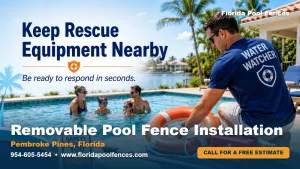
13. Keep Rescue Equipment Nearby
Rescue equipment should be visible and immediately accessible. A reaching pole or shepherd’s crook allows someone to help from the deck without entering the water. A life ring with an attached rope can also help a person remain above water while assistance arrives.
Do not bury rescue equipment inside a garage, locked storage room, or crowded shed. Family members and guests should be able to locate it quickly. Keep equipment dedicated to emergencies instead of using it as a toy.
Inspect the reaching pole, life ring, rope, and first-aid kit regularly. Florida sun and weather can damage plastic, rope, fabric, and packaging. Replace expired first-aid supplies and any rescue item that has become brittle or unreliable.
- Keep a reaching pole beside the pool.
- Store a life ring with an attached rope.
- Maintain a stocked first-aid kit.
- Make the equipment visible to guests.
- Teach adults to reach or throw—without entering unnecessarily.
14. Prepare a Modern Emergency Station
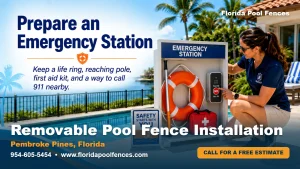
Create a clearly marked poolside emergency station. It does not need to be complicated, but it should place important equipment and information in one predictable location.
Include the property address because a guest calling 911 may not know it. Post basic CPR instructions, emergency contact information, and directions for opening the gate. Keep a reliable way to call 911 nearby. In most homes, the water watcher should keep a charged cellphone within reach while avoiding unrelated phone use.
A weather-resistant emergency call button or modern intercom may make sense for some larger homes, rental properties, or community pools. Whatever system is chosen should be tested regularly and should be easy for an adult guest to understand.
- Post the property address clearly.
- Include CPR and emergency instructions.
- Keep a charged cellphone or modern call device available.
- Store rescue equipment in the same area.
- Test the emergency communication method.
15. Learn CPR and Emergency Response
Adults who supervise a pool should know how to recognize an emergency, call 911, help without creating another victim, and begin CPR. Reading instructions is useful, but hands-on training provides a much stronger level of preparation.
CPR skills should be refreshed. Procedures and recommendations can change, and people lose confidence when they do not practice. Consider training parents, grandparents, older teenagers, babysitters, and regular guests.
During an emergency, send one specific person to call 911 and another person to bring the rescue equipment. Clear directions reduce confusion. Unlock gates and send someone toward the street to guide emergency responders to the pool.
- Complete a recognized CPR and first-aid course.
- Refresh training before certification expires.
- Post the home address near the pool.
- Assign specific emergency tasks.
- Keep gates and access routes clear for responders.
Find training through the American Red Cross water-safety program and its CPR certification resources.

16. Enroll Children in Swimming Lessons
Formal swimming lessons can help children develop confidence, breath control, floating ability, movement skills, and safer behavior around water. Choose a program that fits the child’s age, development, experience, and comfort level.
Ask how the instructor teaches safe entry and exit, turning toward the wall, floating, calling for help, and respecting pool rules. Continue lessons as the child grows. One short course should not be treated as permanent protection.
Even strong swimmers can become tired, injured, disoriented, trapped, or frightened. Swimming lessons never replace a pool barrier or active adult supervision.
- Choose an experienced instructor or recognized program.
- Match lessons to the child’s current ability.
- Continue instruction as skills develop.
- Teach children to ask permission before approaching water.
- Never describe a child as “drown-proof.”

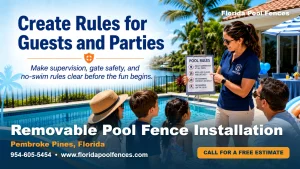
17. Create Rules for Guests and Pool Parties
Guests may not understand the layout of your home, the operation of the pool gate, or the rules your family follows. Explain the safety plan before the party begins—not after children are already in the water.
Name the water watcher and make the assignment visible. Show responsible adults how the gate opens, closes, and latches. Explain that the gate must never be propped open for convenience.
Establish rules for running, diving, rough play, food, glass containers, and entering the pool area without permission. Consider hiring a qualified lifeguard for larger gatherings, but remember that parents and caregivers still have responsibilities.
- Designate the water watcher before swimming begins.
- Explain the gate and barrier system.
- Keep the gate closed during setup and cleanup.
- Count children when they enter and leave the water.
- Continue supervision during non-swimming parts of the party.
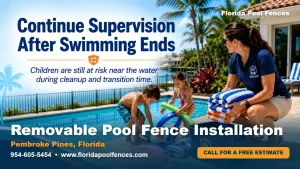
18. Continue Supervision After Swimming Ends
The end of swim time can be one of the most distracting periods. Adults gather towels, change clothes, serve food, clean the deck, move furniture, and talk with departing guests. Children may still be close to the water even though no one considers the pool “open.”
Keep the water watcher in place until every child is inside the home, under the direct care of another adult, or has left the property. The pool barrier should be closed and latched before attention shifts to cleanup.
Count children again. Check the pool, spa, shallow ledges, steps, bathroom, house, and yard. Do not assume a child went inside with someone else.
- Keep the water watcher assigned during cleanup.
- Close and latch the barrier first.
- Remove toys only while children remain supervised.
- Account for every child before adults relax.
- Check the water one final time.
19. Never Use an Older Child as the Primary Supervisor
An older sibling may help remind younger children about rules, but should not serve as the primary water watcher. Teenagers can be distracted by phones, friends, music, food, or their own swimming.
An older child may also overestimate a younger child’s ability or lack the judgment, strength, and emergency training needed to respond. Placing full responsibility on a teenager can endanger both children.
Primary supervision should be handled by a responsible adult who understands the assignment and can maintain full attention. Older children can support the plan by closing gates, reporting unsafe behavior, and immediately getting an adult.
- Assign an adult as the primary supervisor.
- Do not make a sibling responsible for several children.
- Teach older children to call for adult help.
- Keep phones and headphones away from the water watcher.
- Make supervision expectations clear before swimming.

20. Reinspect Everything After Severe Weather
South Florida storms, tropical systems, and hurricanes can damage pool safety equipment. Strong wind can loosen mesh, move poles, stress gates, shift deck anchors, and throw branches or furniture against a barrier.
After severe weather, inspect the entire fence line, gate, latch, net, cover, anchors, doors, windows, alarms, rescue equipment, and pool deck. Do not assume the system is safe because it remains standing.
If strong winds are forecast, removable mesh fencing may need to be removed, rolled, and stored securely according to the manufacturer’s instructions. That creates a temporary period without the barrier, so children must be kept away from the pool. Reinstall the fence promptly after the storm and inspect it before relying on it again.
- Remove storm debris from the deck.
- Inspect mesh, poles, sleeves, and connections.
- Test the gate’s closing and latching action.
- Check pool-net and safety-cover anchors.
- Confirm doors, windows, and alarms still work.
- Repair damage before allowing normal pool access.
Read our detailed article: Should I Take Down My Pool Safety Fence Before a Hurricane or Large Storm?
21. Review Every Layer as a Family
Finish the inspection by reviewing the complete safety plan with everyone in the household. Children should understand that they may not enter the pool area without permission. Adults should know how the barrier works, where rescue equipment is located, and who is responsible for supervision.
Give the same explanation to grandparents, babysitters, houseguests, cleaners, landscapers, and anyone else who may open a door or gate. A safety system is less effective when one person props open a gate, disables an alarm, or forgets to reinstall a net.
Write the plan down and post it in a visible location. Review it after moving furniture, remodeling, changing caregivers, purchasing new equipment, or experiencing severe weather.
- Who is the water watcher?
- Can a child leave the home and reach the pool?
- Does every gate close and latch?
- Are doors, windows, and alarms working?
- Are toys stored away from the pool?
- Can adults clearly see the water?
- Is rescue equipment immediately available?
- Does everyone know the property address?
What Florida Law Says About Residential Pool Safety
Florida’s Residential Swimming Pool Safety Act requires a new residential swimming pool to have at least one qualifying safety feature before final inspection and issuance of a certificate of completion. The options include an isolation enclosure meeting the statutory barrier requirements, an approved safety pool cover, qualifying alarms on doors and windows providing direct pool access, qualifying self-closing and self-latching door devices, or an approved swimming-pool alarm.
When a residential pool barrier is used, Florida law requires it to be at least four feet high on the outside. It may not have gaps, openings, indentations, protrusions, or structural components that could allow a young child to crawl under, squeeze through, or climb over. It must surround the pool and be positioned far enough from the water’s edge to reduce the chance of someone immediately falling into the water after passing through the barrier.
Pool-access gates must meet additional requirements, including opening away from the pool and being self-closing and self-latching. Local building departments may have additional requirements or interpretations, so homeowners should verify the rules that apply to their property.
Review the official statutes:
- Florida Statute 515.27: Residential pool safety-feature options
- Florida Statute 515.29: Residential pool barrier requirements
Pool Safety Matters More Than Who Installs the Barrier
Florida Pool Fences believes that every pool should have a dependable barrier, even when another qualified company installs it. The most important outcome is that a child, pet, visitor, or vulnerable adult cannot reach the water unnoticed.
Homeowners should compare more than price. Ask about fence construction, gate quality, installation methods, warranty coverage, repair service, insurance, documentation, and the company’s ability to help after installation. A low quote is not a good value if the barrier does not fit the property or if the company cannot service the product.
Use the Florida Pool Fences estimate-comparison tool to compare important details. You can also view our South Florida pool safety installation gallery.
For questions about South Florida pool safety, removable pool fences, pool safety nets, or pool safety covers, call 954-605-5454 or visit FloridaPoolFences.com.
Frequently Asked Questions About South Florida Pool Safety
When is World Drowning Prevention Day?
World Drowning Prevention Day is observed annually on July 25. It raises awareness of drowning and promotes practical prevention measures that families, communities, businesses, and public agencies can take.
What is the best pool barrier for a South Florida home?
The best option depends on the home, pool, deck, landscaping, children, pets, and how frequently the pool is used. A four-sided removable pool fence is a strong everyday option for many families. A pool safety net provides low-profile protection over the water. A safety cover can provide a more complete pool lockdown when the pool is not used frequently.
Do swimming lessons replace a pool fence?
No. Swimming lessons improve water skills, but they do not replace active adult supervision, a working gate, alarms, or a physical pool barrier. Strong swimmers can still become tired, injured, trapped, or disoriented.
Are the 2024 South Florida county figures child drowning deaths?
No. Broward County’s 53, Palm Beach County’s 39, Miami-Dade County’s 30, and Monroe County’s 6 are all-age unintentional drowning deaths reported through Florida Health Charts. They should not be described as child-only deaths.
How often should a pool fence be inspected?
Homeowners should perform regular visual checks and test the gate frequently. Complete inspections are especially important after severe weather, landscaping work, construction, parties, furniture changes, or any impact involving the fence or gate.
Does Florida require a residential pool barrier?
Florida requires new residential pools to have at least one qualifying safety feature. A compliant isolation enclosure is one option. Approved covers, certain alarms, certain door devices, and approved pool alarms are other statutory options. Local requirements may add conditions, so confirm the requirements for the property with the appropriate building department.
What should I compare when getting pool-fence estimates?
Compare the total price, gate construction, fence and pole system, installation method, warranty, insurance, safety documentation, repair support, and what happens after installation. Do not compare price alone.