

A Home Depot pool fence can look like an affordable weekend project. Order the sections, rent a drill, and put a barrier around the pool. The part that deserves a closer look is what happens between opening the boxes and having a properly installed fence.
Once you drill into the deck, a measuring mistake becomes a hole in your concrete, tile, or stone. If the layout or drilling angle is wrong, the mesh may hang loose, a corner may pull incorrectly, or the last section may not fit the way you expected.
Randy at Florida Pool Fences estimates that he has received roughly 100 calls from DIY pool-fence buyers who got stuck and wanted professional help. That is his experience with the people who contacted him, not a measure of how often all DIY projects fail. It is a good reason to understand the installation before deciding that the kit price is the project price.
Before you drill your pool deck, get a free professional installation estimate. Compare the complete project while you still have every option open.
In this guide
- What you are buying when you order a Home Depot pool fence
- Plan your Home Depot pool fence route before buying
- Straight sections and corners need different attention
- Pool fence drilling mistakes can leave the mesh loose
- Having instructions is different from being ready to drill
- The gate and the deck deserve their own review
- Compare a Home Depot pool fence with an installed quote
- Already started and the fence does not fit
- Pool safety depends on the completed installation
- Questions to answer before you drill
- Get the installation quote before the first hole
1. What you are buying when you order a Home Depot pool fence
Home Depot sells purpose-made removable mesh pool-fence products, including Pool Fence DIY sections and separate self-closing, self-latching gates. You can see those products in its mesh pool-fence category. Buying from a home-improvement retailer does not, by itself, tell you whether the finished installation will work correctly.
Start with the exact brand and model of the Home Depot pool fence you’re considering. A fence section, a gate, and a complete enclosure are different purchases. Check what is included, what your layout requires, and which instructions apply to each component. Keep the model numbers and installation documents together.
Be careful with products that use “pool” to describe their location. A privacy screen that hides pool equipment serves a different purpose from a child-safety barrier around the water. Read the intended use and documentation rather than relying on a photograph or a category filter.
For a removable mesh system, the decision also includes how the fence is supported beneath the deck. Our DIY pin-fence and pole-fence comparison introduces that construction difference. Ask questions about the specific systems you are comparing. Appearance alone does not establish equivalent construction, installation requirements, or performance.
2. Plan your Home Depot pool fence route before buying
The pool’s dimensions are only a starting point. The fence follows a route across the deck, around obstacles, and through an access point. That route can be longer or more complicated than the rectangle you picture when shopping online.
Walk the proposed line from beginning to end. Look at the house doors, patio furniture, raised spa, steps, planters, and equipment. Consider where people will stand while opening the gate and how they will reach the lawn without unnecessarily entering the pool area.
Then look at the proposed hole locations. A neat line on a sketch may land on a change in surface, a narrow piece of stone, an existing hole, or an area that needs a different installation method. Those conditions should influence the plan before drilling begins.
Measuring accurately means more than reaching the right total footage. The installer must place individual supports correctly and account for the way sections join. A small error repeated along the route can leave an awkward final connection.
For example, a hypothetical homeowner might buy enough mesh for the estimated perimeter but overlook the gate arrangement and a step beside the spa. The quantity could be sufficient while the supplied sections still need a different layout or approved customization.
Keep a simple sketch of your Home Depot pool fence route and the features that interrupt it. Use it to ask for an estimate or manufacturer guidance. It is much easier to revise that drawing than to revise a row of drilled holes.
3. Straight sections and corners need different attention
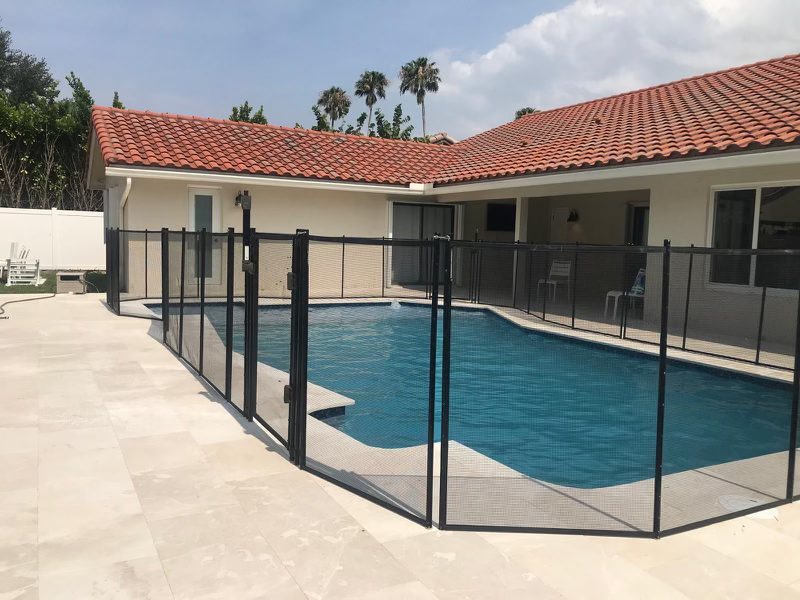
A straight run can make a mesh fence look deceptively simple. Poles appear evenly spaced, and the fabric stretches between them. At a turn, the relationship between the poles and mesh changes.
Randy points to corner layout as one of the details that DIY buyers can underestimate. In the systems and layouts he works with, some corners require different spacing, including a longer spacing than the adjoining straightaway. Applying the same measurement around every turn can leave the fence fitting poorly.
That observation is not a universal spacing instruction. The correct layout depends on the product, the turn, the section construction, and the manufacturer’s method. Do not add an arbitrary amount at every corner or transfer dimensions from a different fence brand.
Pole rotation matters as well. On systems that use molding or a strip to secure the mesh to the pole, the position of that attachment affects how the fabric approaches and leaves the turn. A pole is part of an assembly; treating it as an interchangeable round stick misses that relationship.
This is why a professional looks at the complete corner rather than only the distance between two marks. The adjoining fence runs have to work together. Correcting one side by pulling harder may create a problem on the other side.
Before committing to a Home Depot pool fence installation, ask yourself whether you understand the corner details for your exact system. If the instructions and your actual deck do not line up clearly, resolve that question with the manufacturer or an experienced installer before drilling.
4. Pool fence drilling mistakes can leave the mesh loose
For a Home Depot pool fence, the direction of a hole matters as well as its position. A pole can sit in the intended spot and still lean in a way that prevents the assembled fence from tensioning correctly.
In Randy’s installation experience, some corner arrangements require an appropriate outward drilling angle to help establish tension. The important word is appropriate: it is tied to the system and layout. It does not mean every corner on every fence should lean outward.
The manufacturer of Pool Fence DIY also addresses this issue. Its drilling guidance distinguishes level holes and different lean directions according to the fence route. That is a useful reminder that “drill all the holes straight down” is not a reliable instruction for every removable mesh fence.
The homeowner’s challenge is translating the correct diagram to the correct mark on the actual deck, then maintaining the required direction during drilling. A curved route or abrupt change in direction can make that judgment less obvious than it appears in a short installation video.
A loose section deserves assessment. It may involve layout, pole orientation, drilling angle, an attachment, or a damaged component. Pulling harder on the mesh does not identify which part of the installation is wrong.
Do not enlarge holes, force poles into position, or add improvised hardware to make the fence appear tighter. Get product-specific advice. A fence that looks better after an improvised adjustment has not necessarily been restored to the intended installation.
5. Having instructions is different from being ready to drill
Before you install a Home Depot pool fence, read the manufacturer’s installation information. Pool Fence DIY, for example, has an installation library covering basic layout, drilling, gates, and specialty situations. Read the relevant material before buying tools or opening the drill rental period.
Pay attention to the order of the work. Its layout instructions direct customers using a self-closing gate to the gate-specific layout instructions. Starting with the wrong sequence can affect the rest of the route.
A realistic readiness check is whether you can explain the next step before taking it. Which document covers your gate? Which detail applies to the corner by the spa? What supports the fence under the finished deck surface? What will you do if the installation differs from the diagram?
This is also the time to identify your stopping point. If a sleeve does not fit as expected or the first assembled section behaves differently from the instructions, pause. Continuing around the pool can repeat the same mistake many times.
Borrowed tools and a free weekend do not answer those questions. Neither does general confidence with home repairs. Pool fencing has its own details, and the finished barrier has a safety purpose.
Professional installation may make sense when the layout has several turns, changes in elevation, uncertain deck construction, or a gate arrangement you cannot confidently interpret. A clear estimate lets you evaluate that option before the work becomes a repair project.
6. The gate and the deck deserve their own review
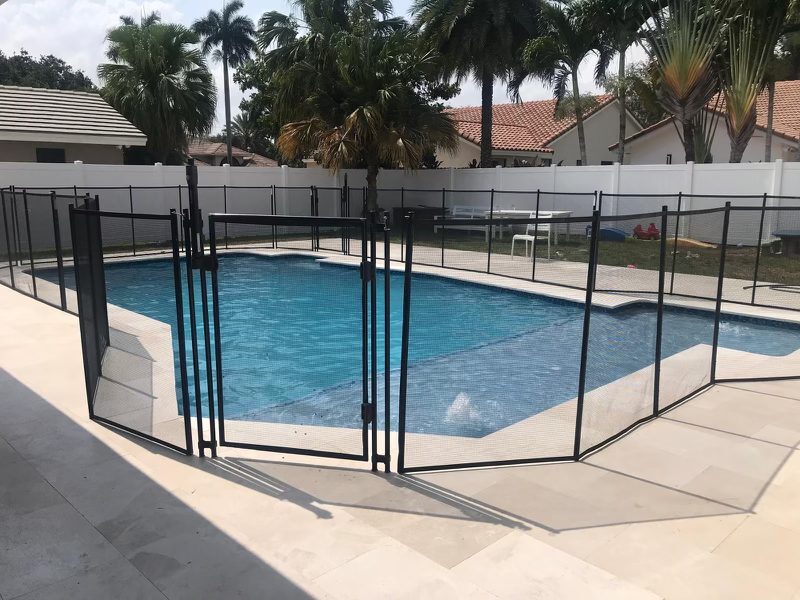
A gate has to work as a moving assembly. Its location, supports, clearance, hinges, and latch must suit the system and the finished surface. Leaving a convenient-looking opening between fence sections is only the beginning of that decision.
Think about how the gate in your Home Depot pool fence will be used every day. Will a chair block the approach? Will a nearby door interfere with it? Does the proposed position encourage someone to leave it open while moving equipment? Resolve those practical conflicts in the layout.
The deck needs equally careful attention. The material visible at the surface does not reveal every condition underneath it. Tell the installer or manufacturer whether you have concrete, pavers, tile, stone, wood, or a transition into soil, and explain what you know about the construction.
Randy has also encountered DIY customers who cracked a deck while using a hammer drill. That is a potential installation problem to plan for, not an inevitable result of using that tool.
Some systems specify a rotary hammer for suitable surfaces. Tool choice and technique must follow the fence manufacturer’s instructions and the requirements of the actual deck material and substrate. If you cannot identify the supporting surface or the appropriate drilling method, get that assessed before starting.
Ask who will evaluate hidden services, the condition of the substrate, and any restrictions on drilling. A homeowner should not be expected to guess what is beneath a finished surface.
Our pool fence installation guide explains the kinds of layout and installation details to discuss with Florida Pool Fences. Bring the gate and the deck into the same conversation, because a change to one can affect the other.
7. Compare a Home Depot pool fence with an installed quote
If you are searching for a cheap pool fence, wanting to control the budget is reasonable. The useful comparison is between two complete approaches to the same pool.
For the Home Depot pool fence option, list the fence sections, required gate, compatible hardware, installation accessories, tools, and any delivery or tax. Separate items you already own from purchases or rentals. Do not assume every accessory is necessary, or that everything required is included.
For the professional option, ask for a written scope covering the fence route, product, gate, installation surface, and any special work. Confirm what is included in the price and what might change after the site is assessed.
Compare these details:
- The same approximate route and enclosure purpose
- The specified fence and gate system
- Work around corners, steps, or changes in surface
- Responsibility for installation and cleanup
- Product warranty and installation-service terms
- Any exclusions involving existing holes or deck repairs
Your own time belongs in the decision, even if you do not assign it an hourly rate. Consider the time to plan, obtain tools, perform the work, and resolve questions. Also consider whether the pool area can remain appropriately secured while the project is unfinished.
DIY can save installation labor when the work goes well. Professional installation can reduce the amount of technical execution you must handle yourself. Neither outcome should be assumed from an advertised section price.
Use our pool-fence estimate comparison to organize the details. Ask for the installed number before deciding whether the potential savings justify the work for your particular deck.
8. Already started and the fence does not fit
If your Home Depot pool fence does not fit, stop before drilling additional holes. A partially completed route gives an installer more information than a description over the phone, but it does not guarantee the existing work can be retained.
Take clear photographs from several directions. Include the whole fence route, the problem corner or section, the gate area, and close views of the poles, sleeves, and product label. Show the condition as it is rather than forcing the fence into position for the photograph.
Keep the receipt, model information, instructions, and unused components. Explain what has been drilled or cut and what happened when you attempted assembly. That helps the person assessing the job distinguish the product you have from a similar-looking system.
Ask specifically whether the company evaluates customer-purchased kits. Some installers work only with the systems they supply. A request for an estimate is not an agreement to install an outside product.
Existing holes also need inspection. Their position, size, depth, angle, and condition may not suit the proposed fence. The assessment may identify usable work, required changes, or a different route, but those possibilities should not be promised before inspection.
Do not rely on an unfinished, loose, or damaged fence as a functioning pool barrier. Keep children away from the pool area, maintain appropriate supervision, and arrange a suitable protection plan while the problem is resolved.
9. Pool safety depends on the completed installation
A retail listing for a Home Depot pool fence cannot approve the finished barrier for your property. The actual fence, gate, openings, surrounding objects, and access from the house all matter. Ask your local building department which requirements and approvals apply before committing to the work.
For broader background, our Florida pool fence laws guide can help you prepare questions. Your property-specific requirements still need to be confirmed with the appropriate authority.
The U.S. Consumer Product Safety Commission’s Pool Safely guidance recommends barriers and self-closing, self-latching access gates alongside active adult supervision, swimming skills, and CPR knowledge. No fence makes a pool childproof or replaces supervision.
After installation, learn how to use and maintain the specific system. Keep the gate functioning, follow the manufacturer’s inspection guidance, and address damaged components promptly. Keep furniture and other potential climbing aids away from the barrier.
10. Questions to answer before you drill
Can a homeowner install a mesh pool fence?
A capable homeowner may be able to install a suitable DIY system by following its instructions and meeting applicable requirements. The decision should depend on the actual product, deck, layout, tools, and skills. Difficulty varies from one pool to another.
Will a professional use the Home Depot pool fence kit I bought?
Ask before assuming so. An installer may supply only its own systems or may need to inspect your product and partially completed work before deciding. Availability of parts, installation requirements, and warranty responsibilities can affect the answer.
Can new fencing use my existing holes?
Possibly, but the holes and proposed system must be evaluated together. Matching the visible spacing is not enough to establish compatibility. Do not order a replacement on the assumption that every removable mesh fence uses the same supports.
Why is my DIY pool fence loose?
Several causes are possible, including layout, pole orientation, drilling angle, attachments, or component condition. Get an assessment based on the specific fence. A photograph may help identify questions, but it cannot establish that the whole barrier is safe.
11. Get the installation quote before the first hole
A Home Depot pool fence may be the option you are considering, but you can still compare professional installation before committing your deck to that decision.
Send Florida Pool Fences a few pool photographs, your city, and any approximate route measurements you already have. Point out corners, steps, a raised spa, and the surface where the fence would go. If you have selected a kit, include its brand and model in your questions.
Request your free pool-fence installation estimate before you drill. You can make the budget decision with the installation work in view, while the layout is still easy to change.