
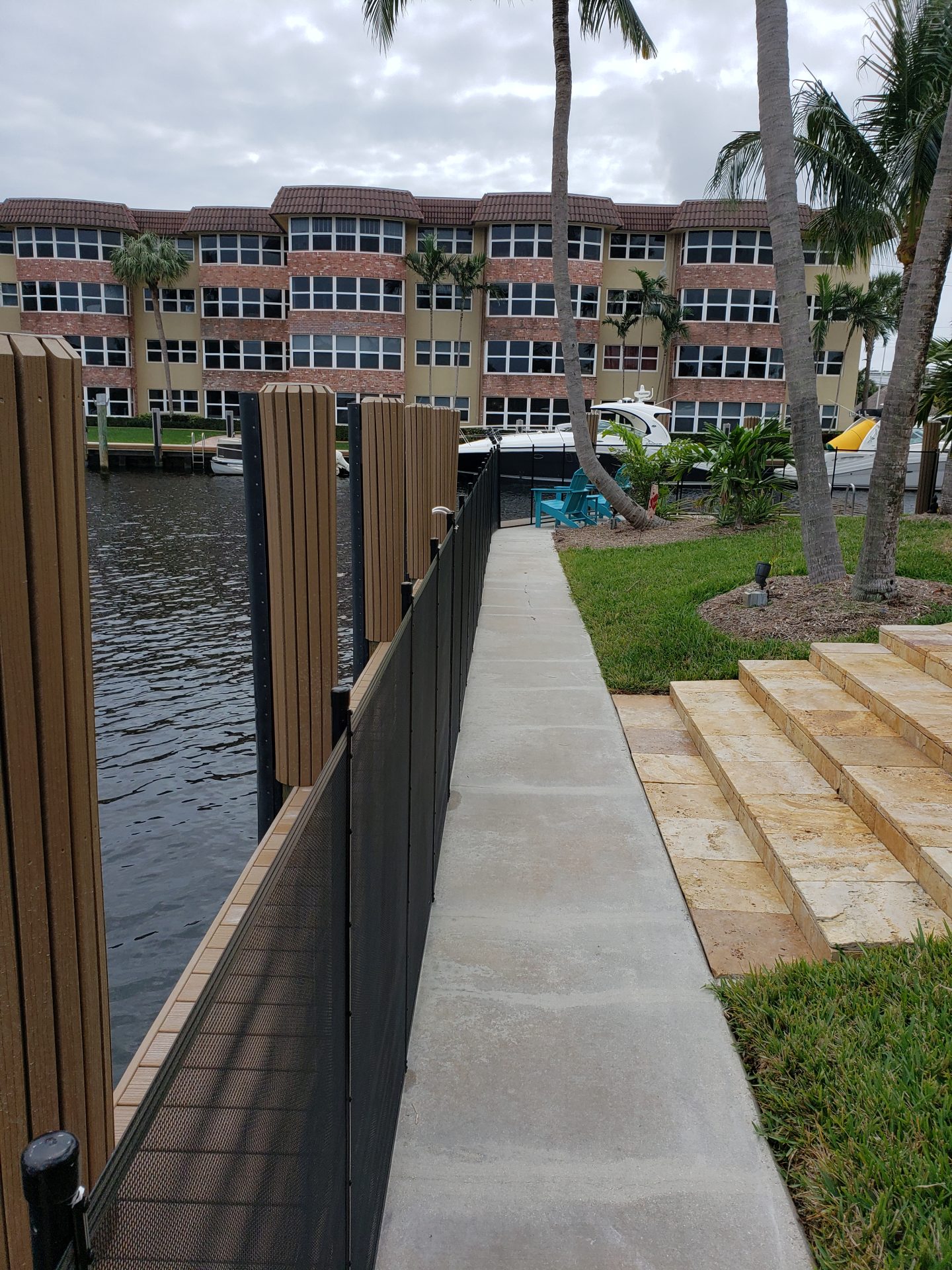
Florida Pool Fence Laws Explained: 12 Requirements Homeowners Need to Pass Inspection
Updated July 30, 2026. This guide reflects the Florida statutes and the 8th Edition (2023) Florida Building Code in effect on the publication date.
Florida pool fence laws do not simply say “install a four-foot fence.” For a new residential pool to pass final inspection, the property must have an approved safety feature, and any fence used as the pool barrier must meet detailed rules for height, openings, placement, gates, latches and access from the house. Your city or county may add a stricter requirement, so the statewide rules are the starting point—not always the last word.
For many South Florida homes, a properly designed removable pool safety fence is the clearest way to create a separate barrier between the house, yard and water. But a fence is not the only option named in the state statute. The real question is which safety method appears on the approved plans and what the building inspector will expect to see working on inspection day.
Short answer: A compliant pool barrier is generally at least 48 inches high on the outside, difficult for a young child to climb or pass through, placed far enough from the water, and fitted with a gate that swings away from the pool, closes by itself and latches by itself. That quick description is useful, but it leaves out several details that commonly cause failed inspections.
Florida Pool Fence Laws vs. Florida Pool Barrier Requirements
Homeowners often use “law” and “code” as if they mean the same thing. They do not. A Florida pool project can be affected by three layers of requirements:
- Florida Statutes, Chapter 515: The Residential Swimming Pool Safety Act establishes the statewide safety-feature options for new residential pools and the basic characteristics of a barrier.
- Florida Building Code: The building code provides the measurements and construction details used for plan review and inspection. The current residential pool provisions are in Chapter 45.
- Local rules: A county or city may have an equal or more stringent pool-safety ordinance, zoning rule, permit procedure or required form.
The Florida Residential Swimming Pool Safety Act says that a new residential pool must have at least one approved safety feature to pass final inspection and receive a certificate of completion. The Florida Building Code residential pool provisions contain the inspection-level details for barriers.
This is why advice from a neighbor in another city can be wrong for your permit. The neighbor may be describing a different barrier type, a pool built under an older code edition or a municipality with a different local rule. The authority having jurisdiction—usually the city or county building department—makes the final call for the property and permit in front of it.
The Five Safety-Feature Options in Florida Statute 515.27
Florida’s statewide statute lists five paths, not four. A homeowner does not automatically have to choose a fence under the statute, but the selected option must satisfy its applicable standard and must be accepted for the project. Local rules and the approved permit plans can be stricter.
| Statewide option | What the statute requires | What the homeowner should confirm |
|---|---|---|
| Pool barrier or enclosure | The pool is isolated from access to the home by an enclosure meeting Section 515.29. | Barrier layout, height, openings, gate operation, latch location and local approval. |
| Approved safety pool cover | A manual or power-operated cover meeting ASTM F1346-91 performance standards. | That the product is a qualifying safety cover—not a floating solar or debris cover—and that documentation is available. |
| Exit alarms | Every door and window providing direct access from the home to the pool has an exit alarm rated at least 85 dBA at 10 feet. | Which openings require protection, what listing the local department requires and how alarms will be tested. |
| Self-closing, self-latching doors | Every door providing direct pool access has the required device, with the release mechanism at least 54 inches above the floor. | That every applicable door closes and positively latches without being pushed. |
| Water-entry pool alarm | An independently certified ASTM F2208 pool alarm detects accidental or unauthorized entry into the water. | Product certification, installation instructions and local acceptance for the permit. |
A professionally fitted pool safety cover may qualify when it meets the required standard. Ordinary covers do not. The same principle applies to alarms: a wearable child alarm is specifically excluded from the statute’s water-entry alarm option.
Pool safety nets deserve a separate note. Section 515.27 does not name “pool net” as a standalone statewide category. Some Florida permitting authorities approve tested net systems for particular projects, but acceptance depends on the product documentation, plans and local authority. If you are considering a pool safety net, get written confirmation of the permit path before relying on it for final inspection.
Florida Pool Fence Laws: 12 Requirements Inspectors Actually Check
The following points combine the statewide barrier rules with the current building-code details that matter during a Florida pool fence inspection. They are not a substitute for your approved plans, because a local amendment or project-specific condition can be stricter.
1. The Barrier Must Be at Least 48 Inches High
The statewide minimum is four feet, measured on the side facing away from the pool. Inspectors measure from the finished grade or walking surface, not from wherever the installer finds it convenient to hold the tape. A planter, raised soil, step, curb or sloped deck outside the barrier can reduce the effective height.
The Florida pool fence height requirements are a minimum, not a promise that 48 inches passes everywhere. Unincorporated Broward County, for example, publishes an additional five-foot zoning requirement for residential pools and spas. Always build to the stricter applicable rule.
2. The Bottom Gap and Other Openings Must Stay Within Code
Under the current residential building code, the maximum clearance between grade and the bottom of a ground-level barrier is generally two inches, measured from the outside. Openings in the barrier cannot allow a four-inch-diameter sphere to pass through. These are separate measurements: a fence can pass the picket-spacing test and still fail at the bottom.
Watch transitions closely. Pavers may settle, turf may compress, and a gap can grow where the deck meets grass or where the fence crosses a drain. Corners, gate hinges and changes in elevation are the spots most likely to be overlooked.
3. The Fence Cannot Create an Easy Climbing Route
A barrier cannot have gaps, protrusions, indentations or structural components that let a young child crawl under, squeeze through or climb over. Decorative fences and fences with horizontal rails have additional spacing rules because the rails can become a ladder. Chain-link and diagonal designs also have specific opening limits.
Compliance is about the installed condition, not just the fence panel. A nearby air-conditioning unit, pool pump, bench, planter, storage box or low wall can create a step over an otherwise compliant barrier. Move climbable objects before inspection and keep them away afterward.
4. The Barrier Line Must Fully Control Access to the Pool
The barrier must surround the pool and obstruct access from the residence and the area outside the barrier. A backyard perimeter fence may count only if it sits on the pool perimeter, functions as part of the pool barrier and meets every applicable pool-barrier requirement. A tall privacy fence around the property is not automatically enough.
This distinction causes confusion in South Florida homes with screened patios or fenced yards. An inspector follows the entire access route: from the home, from the yard, through side gates and around every termination point. One uncontrolled path can defeat the whole layout.
5. A Removable Child Barrier Must Be Properly Positioned
Florida’s residential code defines “sufficiently away” from the water for a removable child barrier as at least 20 inches. The purpose is simple: if someone gets through the barrier, they should not immediately fall into the pool. Walls and compliant screen enclosures used as barriers can have different placement allowances.
The 20-inch measurement is easy to lose near a curved pool edge, raised spa, narrow deck or diagonal fence run. Measure the closest point between the barrier and water around the entire route—not just the comfortable straight section.
6. The Pool Gate Must Swing Outward, Away From the Water
A gate providing access to the pool must open away from the pool. That direction matters because it helps the gate resist being pushed into the pool area and works with the required closer. A gate that swings inward can fail even if its height and latch are correct.
Confirm the swing before drilling the deck or setting posts. Reversing a gate late in the job can affect clearances, hinge placement and the entire fence route.
7. The Gate Must Close by Itself
The self-closing pool gate requirements mean the gate must return to the closed position without a person pulling or pushing it. Test it from several open positions, including only a few inches open. A gate that closes from fully open but stalls when barely cracked may not do its job and may not pass.
Wind is not a substitute for a gate closer. The closer or spring system must work reliably under ordinary conditions, and the gate should not drag on the deck, bind at the hinge or stop short because posts are out of alignment.
8. The Gate Must Latch Automatically
Closing is only half the test. The gate must also engage its self-latching locking device without anyone lifting, slamming or manually setting the latch. Inspectors often cycle the gate repeatedly because an inconsistent latch is not a dependable barrier.
Gate sag is a common problem on older installations. If the latch only catches when the gate is lifted by hand, repair or adjust it before the inspection. Do not tape, tie or prop the gate open while the barrier is expected to be in service.
9. The Latch Release Must Be Out of a Young Child’s Reach
The code places the self-latching locking device on the pool side of the gate. If the release is at least 54 inches from the bottom of the gate, the release mechanism may be on either side, provided a young child cannot reach it over the top or through an opening from outside the barrier.
The gate and nearby barrier also have a tight opening restriction around the release mechanism. Avoid treating “54 inches” as the only latch rule. The side, reach path and surrounding openings all matter.
10. A Removable Fence Still Needs a Secured Termination
At least one end of a removable child barrier must not be removable without tools. Otherwise, a person could create an opening at the end without operating a compliant gate. The permit plan may require the secured termination location to be shown.
The 8th Edition also requires mesh safety barriers to comply with ASTM F2286. Ask for product compliance information and make sure the installed layout, poles, mesh, gate and terminations match the submitted system rather than a mix of unrelated components.
11. Doors and Windows From the House Must Match the Chosen Design
If a dwelling wall is used as part of the barrier, direct access from the house becomes a major inspection issue. Depending on the approved safety method and barrier design, doors and windows may need code-compliant exit alarms, or doors may need self-closing and self-latching hardware. The statute’s exit-alarm option applies to all doors and windows providing direct access.
Test every applicable opening, including sliders, French doors and pass-through windows. An alarm sitting in its box does not count. If a separate isolation fence keeps the house outside the pool enclosure, the access analysis may be simpler, which is one reason many families choose that layout.
12. Screens, Aboveground Pools and Natural Features Need Specific Approval
A standard screen enclosure can serve as part or all of a barrier when it meets the applicable code. Screen doors must still control access and operate correctly. Torn panels, gaps at the bottom and a door that does not close or latch can undermine the enclosure.
An aboveground pool structure may serve as its barrier if it meets the barrier rules. Ladders or steps must be secured, locked, removed or surrounded by a compliant barrier. Canals, lakes, bulkheads and similar features are not automatic substitutes; the building code allows certain adjacent features only when the authority having jurisdiction approves them.
South Florida Local Rules Can Be Stricter
Chapter 515 expressly recognizes local pool-safety ordinances that are equal to or more stringent than the state act. That matters in a region where a mailing address, municipality boundary or unincorporated area can change the reviewing department.
Miami-Dade County
Miami-Dade’s official swimming pool permit guidance states that the barrier top must be at least 48 inches above grade on the side facing away from the pool and directs homeowners to county-code sections for additional details. The county also uses an owner certification stating that a pool will not be used or filled until a separate permit and final inspection for an approved safety barrier are obtained.
Inside Miami-Dade, your city may be the permitting authority rather than the county. Confirm the exact agency before assuming the county procedure applies to your address. Homeowners in the area can also review the company’s Miami pool safety fence guide for local installation considerations.
Broward County
Broward’s official residential swimming pool barrier form asks the applicant to identify the protection method and provide plans and product compliance information. The same document notes that unincorporated Broward zoning requires residential pools and spas to be enclosed by a fence at least five feet high or by an open-mesh screen enclosure.
That five-foot note is the clearest example of why “Florida only requires four feet” can be incomplete advice. Incorporated cities in Broward may administer their own permits and local rules, so verify the jurisdiction for the specific property.
Palm Beach and Monroe Counties
Palm Beach County treats a pool barrier fence or rail as a permit type, while municipalities within the county may have their own submittal process. Monroe County inspection lists include a pool-barrier inspection, and the Keys add site conditions that can complicate placement, including narrow decks, elevated construction, waterways and limited setbacks.
Do not assume a solution accepted for a Broward deck will be approved unchanged in Boca Raton, Jupiter, Key Largo or Islamorada. Ask for the barrier checklist, permit type, required product documentation and applicable zoning rule for the address.
What About Existing Pools, Older Fences and Home Sales?
The Residential Swimming Pool Safety Act was written around new residential pools and final inspection. That does not support the blanket claim that every older Florida pool must automatically be rebuilt to the current Chapter 515 barrier standard. It also does not mean an old, unsafe or unpermitted barrier is automatically acceptable.
An existing property can still face requirements because of a local property-maintenance ordinance, an open or expired permit, a new fence permit, a pool renovation, a change in use, a vacation-rental rule, an insurance inspection or a code-enforcement case. If the permit history is unclear, look it up before replacing pieces at random. A repair that changes the barrier may trigger current requirements for the work being permitted.
There is also false information online claiming that Florida adopted a 2026 law requiring every home sale with a pool to trigger barrier compliance and a mandatory pool inspection. It did not. Florida Senate Bill 610 died in committee on March 13, 2026, along with related proposals. As of this article’s publication date, that proposed statewide home-sale requirement is not law.
A buyer, lender or insurer can still request an inspection or correction as a private condition of the transaction or coverage. A local violation does not disappear because the statewide sales proposal failed. The accurate answer depends on the property’s permit record, jurisdiction and existing condition.
Do You Need a Permit for a Pool Fence in Florida?
There is no honest one-word answer for every Florida address. For a new pool, the barrier method is normally part of the approved pool-permit documents and must be ready for final inspection. A separate barrier or fence permit may also be required. For an existing pool, some jurisdictions require a permit for a new or replacement pool barrier while others treat certain removable installations differently.
Before signing a contract, call or check the building department for the property and ask:
- Which agency has jurisdiction over this address?
- Is the barrier covered under an active pool permit, or is a separate fence/barrier permit required?
- Which code edition and local amendments apply?
- Is a site plan or barrier layout required?
- What manufacturer or ASTM documentation must be submitted?
- Does zoning require a taller perimeter fence than the pool code minimum?
- Which inspection must be scheduled before the pool is filled or used?
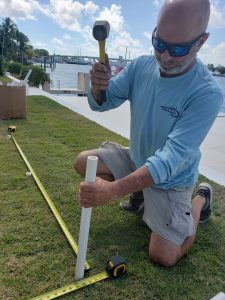
A proper pool fence installation process starts with the layout, surface type, gate location and local requirements—not with drilling the first hole. If the fence is being installed for an open pool permit, the approved plans control. Changes should be cleared before installation rather than explained to the inspector afterward.
Florida Pool Fence Inspection Checklist for Homeowners
Use this checklist the day before the inspection. It will not override the approved plans, but it catches the physical problems that inspectors can see and measure quickly.
- Confirm the paperwork. Have the permit number, approved barrier plan, manufacturer documentation and any required certification available.
- Measure the height. Check at multiple locations from the side away from the pool, especially near slopes, planters and steps.
- Measure the bottom clearance. Inspect the full route, including turf, drains, paver transitions and low spots.
- Check every opening. Look at fence mesh or pickets, corners, hinges, gate edges, terminations and connections to walls or screens.
- Clear the climbing zone. Move furniture, toys, storage boxes, planters, coolers and equipment that could act as a step.
- Test the gate repeatedly. Release it from fully open, half open and barely open. It should close and latch every time.
- Verify the swing. The gate must open outward, away from the pool.
- Check the latch location. Confirm its height, side and reach path match the approved design and code.
- Inspect fence ends. Make sure the required removable-fence termination cannot be released without tools.
- Test doors, windows and alarms. If the house is part of the approved safety method, every required device must be installed and working.
- Inspect the screen enclosure. Repair torn screen, loose framing, gaps and doors that fail to close or latch.
- Restore the barrier after use. A removable fence stored in the garage does not protect the pool and will not satisfy an inspection that requires it installed.
For product questions, upkeep and installation details, see the Florida Pool Fences homeowner FAQs.
Common Reasons a Florida Pool Barrier Fails Inspection
The Homeowner Focuses Only on Fence Height
A four-foot panel can still fail because the grade is raised outside it, the bottom gap is too large, the gate swings the wrong direction or the latch is reachable. Inspectors evaluate the complete system.
The Gate “Almost” Closes
A gate that needs a final nudge is not self-closing. A latch that catches only after lifting the gate is not reliably self-latching. These are mechanical problems, not paperwork problems.
The Yard Fence Is Assumed to Be the Pool Barrier
The perimeter fence may leave the pool open to the house or may have ordinary side gates that do not meet pool-gate rules. Map the full access route before deciding which structure is the legal barrier.
The Installer Ignores the Water-Edge Clearance
A removable fence may look better tucked tight against the pool, but the current code calls for at least 20 inches from the barrier to the water. Curves, spas and narrow deck areas require deliberate planning.
Furniture and Equipment Create a Ladder
A code-compliant fence can become climbable after someone parks a grill, bench or storage chest beside it. Inspectors look at the installed surroundings, and homeowners should keep that area clear after approval.
The Product Documents Do Not Match the Installation
A plan may identify a tested mesh-barrier system, gate and termination method. Substituting different hardware or combining parts from unrelated systems can create a documentation and performance problem.
The Home-Sale Rumor Is Treated as Law
The proposed 2026 transfer requirement did not pass. Do not pay for unnecessary work because a website describes a failed bill as current law. Do correct real safety problems, open permits and local violations based on verified requirements.
What Affects the Cost of a Compliant Pool Fence?
A statewide “price per foot” is not reliable enough to quote as law-related guidance. The real price depends on the pool and deck, and a cheap layout that cannot pass the required inspection is not a bargain. Get a written, property-specific estimate.
The main cost factors include:
- Linear footage: A tight isolation fence around the pool uses less material than a large deck enclosure, but the route still has to maintain safe clearances.
- Number and type of gates: Self-closing, self-latching gates and high-quality hardware cost more than manual openings, but the approved design may require a gate.
- Deck surface: Concrete, travertine, brick pavers, turf, wood, dirt and grass require different drilling, sleeves, footings or stabilization.
- Layout complexity: Curves, elevation changes, narrow areas, raised spas and connections to walls or screen enclosures add labor and planning.
- Fence system and mesh: Product strength, transparency, pole construction, UV resistance, warranty and tested compliance affect cost.
- Permit and documentation needs: Site plans, permit fees, engineering or product compliance submissions vary by jurisdiction and project.
- Repairs to existing conditions: Settled pavers, damaged screens, misaligned gates and unsafe termination points may need correction before approval.
Compare estimates by scope, not just total price. Each quote should state the fence route, footage, gate count, surface assumptions, hardware, permit responsibility, product, warranty and any excluded repairs. A vague estimate makes it impossible to know whether two companies are pricing the same job.
How to Choose a Qualified Pool-Fence Company
A qualified installer should be able to explain how the proposed route controls access, where the gate will go, how the surface affects the installation and which local requirements still need confirmation. Be cautious if the answer to every code question is simply, “We always do it this way.”
Ask these questions before hiring:
- Have you installed this barrier system in my city or permitting jurisdiction?
- What exact product and gate hardware are included?
- Does the mesh system comply with ASTM F2286, and can you provide the documentation?
- How will the layout maintain required height, bottom clearance and distance from the water?
- Where is the tool-secured termination for a removable fence?
- Who confirms whether a permit is required, and who pulls it if needed?
- Will the gate close and latch from several open positions?
- How are pavers, turf, grass or changes in elevation handled?
- What is covered by the written warranty?
- Will I receive a drawing or written scope showing the final route and gate location?
Also confirm that the company is insured and authorized to perform the contracted work in the jurisdiction. If a permit is required, verify who is named on it and do not accept a request to misdescribe the project to avoid review.
Frequently Asked Questions About Florida Pool Fence Laws
Does every Florida pool have to have a fence?
No. For a new residential pool, Section 515.27 lists five safety-feature options, and a compliant barrier is one of them. An approved safety cover, qualifying exit alarms, qualifying self-closing and self-latching doors, or an independently certified ASTM F2208 water-entry pool alarm may satisfy the statewide statute. The building code, local ordinance and approved plans may impose additional or stricter requirements, so do not select an alternative without confirmation from the permitting authority.
Is the required pool fence height four feet or five feet in Florida?
The statewide barrier minimum is four feet, measured on the outside. A local zoning or safety rule can be higher. Unincorporated Broward County’s published barrier form notes a five-foot enclosure requirement, while Miami-Dade’s county guidance states a 48-inch minimum. The correct number is the strictest requirement that applies to your address and permit.
Can my backyard privacy fence count as the pool barrier?
Possibly, but not merely because it is tall. It must be positioned and used as part of the pool barrier, meet the applicable height and anti-climb rules, control every access path, and have compliant gates. If the pool remains directly accessible from the house or through an ordinary side gate, the perimeter fence may not provide the required isolation.
Does a removable mesh fence pass a Florida pool inspection?
It can when the complete installed system satisfies the code and approved plans. That includes height, bottom clearance, openings, placement, ASTM F2286 compliance, a tool-secured termination and a gate that swings away from the pool, closes by itself and latches by itself. “Removable” does not mean the fence may be absent while it is serving as the approved barrier.
Does a screen enclosure count as a pool barrier?
A standard screen enclosure may serve as part or all of the barrier if it meets the applicable requirements. Doors must control access, and gaps, damaged screening or failed closing and latching hardware can cause a problem. If the house opens directly into the screened pool area, the approved design must also address those doors and windows.
Can a pool safety cover replace a fence?
Florida’s statute recognizes an approved safety pool cover meeting ASTM F1346-91 as a safety-feature option. A solar blanket, leaf cover or ordinary tarp is not the same product. Confirm the cover’s certification, installation and acceptance under the local permit before relying on it instead of a barrier.
Can a pool safety net replace a fence?
Do not assume it can. Pool nets are not separately named in Section 515.27’s statewide list, although some local authorities approve tested net systems for specific projects. The safe approach is to submit or review the manufacturer’s documentation and obtain acceptance from the building department before installation.
Do Florida pool gates have to be locked with a key?
The core inspection requirement is a self-closing gate with a self-latching locking device positioned so a young child cannot operate it from outside. A key-lockable latch can add control, but a key lock does not cure a gate that fails to close and latch automatically. The installed device still has to meet the approved code details.
Will a Florida home sale trigger a mandatory pool fence inspection?
Not under the failed 2026 statewide proposal. SB 610 and related bills would have added pool-safety requirements tied to certain property transfers, but they died in committee. A buyer, insurer, lender, municipality or home inspector may still identify a barrier issue, and an open permit or local violation can still affect the transaction.
Is an older pool “grandfathered” from every current safety rule?
That statement is too broad. Chapter 515 focuses on new residential pools, but older properties can be affected by the code edition under which they were permitted, local ordinances, renovations, replacement work, open permits, rental rules and code enforcement. Check the permit history and ask the current authority what standard applies to the work or violation at issue.
What happens if the pool barrier fails final inspection?
The inspector generally records the failed items or corrections needed, and the responsible party must fix them and request reinspection. The pool may not receive final approval or a certificate of completion until the required safety feature is accepted. Do not fill or use a new pool contrary to permit conditions while a required barrier inspection remains open.
Who should I call before installing a pool fence?
Start with the city or county building department that has jurisdiction over the property. Ask for the residential pool-barrier checklist, permit requirements, local amendments and required product documentation. Then have an experienced installer design the route around those confirmed requirements.
The Practical Bottom Line
Florida pool fence laws establish a statewide safety floor, but passing inspection depends on more than owning a four-foot fence. The barrier must work as a complete system: correct height, controlled openings, safe placement, no climbing route, a properly secured end and a gate that swings outward, closes and latches every time. The house, screen enclosure, yard fence and local zoning rules can all change the final design.
Confirm the permitting authority first, compare the proposed layout with the approved plans, and test the installed barrier before the inspector arrives. That approach prevents the most common failures and avoids paying twice for a fence route or gate that never had a realistic chance of approval.
Florida Pool Fences installs pool safety barriers throughout Miami-Dade, Broward, Palm Beach and Monroe counties. To discuss your pool, deck surface, gate location and local inspection needs, request a free pool fence estimate. Final code interpretation and permit approval remain with the local building official.